THE STARTING POINT
Choose the business outcome first, then the process, data and technology required to support it.
Start with a business outcome, not a software list
A digital transformation roadmap sequences changes to processes, information, systems and capability so the business can work better. For a small company, the most useful roadmap may be quite modest: dependable enquiry ownership, less duplicate entry, clearer delivery planning and management information that arrives in time to support decisions.
Begin with the outcomes that matter. Are customers waiting too long, managers working from conflicting numbers or staff repeatedly copying information between systems? Describe the problem and its effect before considering products. Buying a modern platform does not automatically resolve unclear responsibilities or inconsistent definitions.
The roadmap should connect each proposed investment to an observable improvement and an owner. It should also explain dependencies and the work the team must do. A list of tools with target installation dates is only part of the plan. The business needs to know how the new method will be adopted, maintained and evaluated after the supplier has completed the setup.
Map the current process and information flow
Trace a few representative customer or operational journeys. Record where information enters, where it is stored, who changes it and which systems depend on it. Include spreadsheets, email and informal workarounds. These often carry important business rules that are absent from the official system description.
Identify duplicate entry, inconsistent records, missing ownership and manual reconciliation. Ask why each workaround exists. It may compensate for a genuine limitation, unclear access or an exception the current software does not handle. Removing it without understanding the purpose can create a new failure even if the replacement looks simpler.
Use the process-mapping guide to keep the review grounded in real work. For an illustrative service company, a late delivery problem may begin with a sales commitment recorded in a message but not transferred to scheduling. The first improvement could be a clearer handoff and shared record, rather than a complete replacement of every system in the business.
Establish data ownership before building automation
Define the important records and their sources of truth. Decide who owns customer details, service definitions, prices, job status and management measures. Agree how duplicates, corrections and changes are handled. Automation built on inconsistent records can make errors move faster without making the underlying process more reliable.
Start with the data required for the chosen outcome. A quotation improvement may need complete scope, approved pricing and customer contact information. It may not require a company-wide data-cleaning programme before any useful progress is possible. Keep the boundary proportionate while identifying dependencies that genuinely block the work.
For reporting, write a metric dictionary before connecting dashboards. The KPI dashboard guide explains the definition, owner and reconciliation needed. Two systems producing different sales totals may be using different dates or statuses rather than one being wrong. Resolve the meaning before building an integration that simply transfers the disagreement into a more attractive chart.
Prioritise use cases by value, feasibility and risk
Describe each use case as a task or decision with a clear input and output. Estimate the current effort, problem frequency and business effect. Then assess the quality of available data, process stability, integration needs and ability to verify the result. A narrow, repeatable task is often easier to test than a broad ambition to automate an entire department.
Consider failure consequences. Drafting an internal summary for review is different from automatically making a consequential customer or financial decision. Define where a person must review, approve or intervene. For AI use cases, NIST's voluntary AI Risk Management Framework offers a useful risk-management reference; it is not UAE law or a certification that makes a particular system safe.
Use a prioritisation matrix to compare the candidates, then check dependencies and capacity. Avoid assigning a high score simply because a technology is fashionable. The roadmap should favour work with a credible benefit, a practical owner and a manageable way to test quality before the business becomes dependent on it.
Sequence foundations, pilots and wider rollout
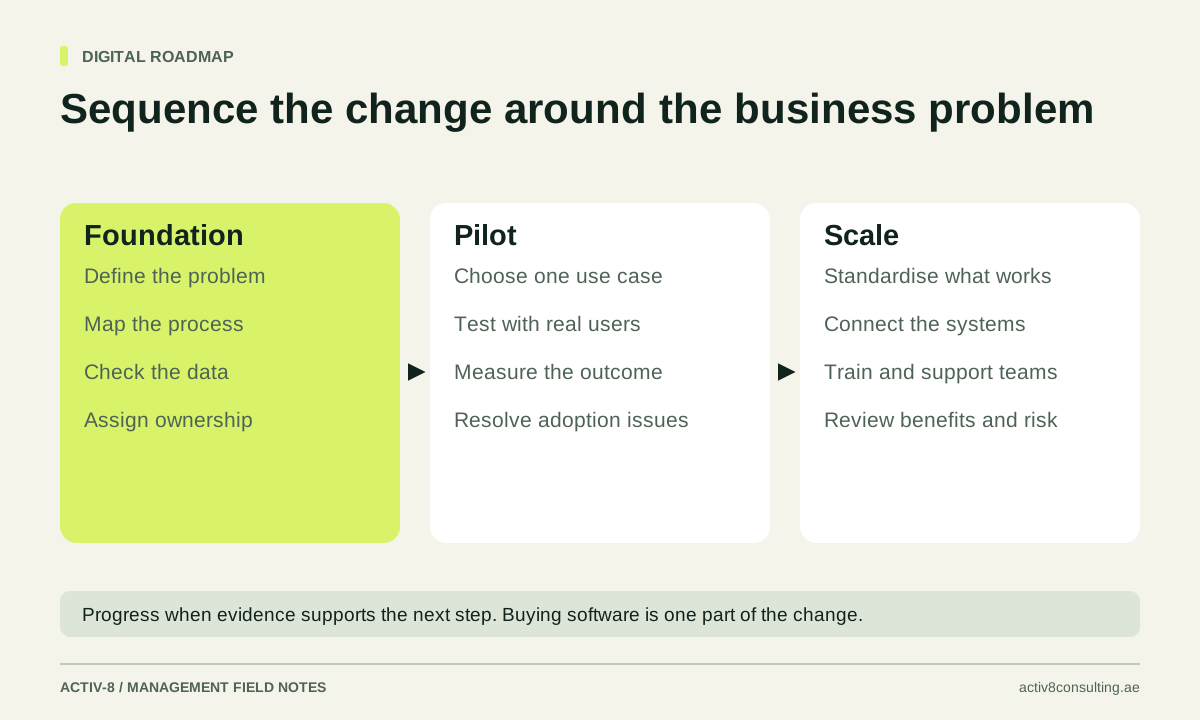
Organise the roadmap around what must be true before the next commitment. A CRM improvement may need agreed stages and ownership before reminders are automated. A reporting project may need reliable definitions before dashboards are distributed. An AI knowledge assistant may need an approved information source and access boundaries before staff use it with live business material.
Use bounded pilots to test the uncertain parts. Define the sample, quality checks, expected benefit and decision at the end. Include awkward cases, not only the simplest demonstrations. The operational efficiency calculator can help compare time and running costs, provided review and exception handling are included.
Plan rollout only after the pilot provides sufficient evidence. Identify migration, training, communication, support and fallback work. Leave capacity for corrections. A roadmap that schedules every week at full project load while ignoring daily operations is likely to create delays or pressure to skip important checks. The sequence should reflect the team's actual ability to absorb change.
Evaluate suppliers and integrations against the work
Use the agreed use case as the evaluation brief. Ask suppliers to demonstrate the normal process and common exceptions using appropriate test information. Check what is standard, what requires configuration and what depends on another product or paid service. A demonstration should reveal the work required to make the solution useful, not only its most polished feature.
Clarify data access, export, retention, support and ownership. Understand the recurring cost and what happens if the service changes or becomes unavailable. Review security and privacy arrangements with the appropriate specialists for the data and activity involved. Do not assume a generic product claim answers the specific needs of your business.
For integrations, define the source and destination fields, failure handling, duplicate prevention and responsible owner. Test a concrete record through the complete process and verify the result in the receiving system. A connector being switched on does not establish that the business outcome works. This evidence is especially important where a missed or duplicated record could affect a customer commitment.
Make adoption and ownership part of the roadmap
Identify who will use the new method and what behaviour must change. Provide realistic practice, clear instructions and a route for problems. The change management guide explains how to distinguish awareness, readiness, adoption and outcomes. A system launch is a milestone, not the end of the change.
Assign a permanent business owner and an appropriate technical support route. Decide who approves changes, monitors quality and reviews costs. Avoid leaving the system dependent on one enthusiastic employee or an undocumented supplier configuration. Keep enough documentation and access governance to maintain continuity when people or providers change.
Review the original business measure after rollout. If response time or reporting reliability has not improved, investigate whether the issue is adoption, design or the original diagnosis. Do not treat usage alone as proof of value. The roadmap should evolve through evidence, with unsuccessful experiments stopped or redesigned rather than retained because the software has already been purchased.
Keep the roadmap understandable and funded
Summarise each initiative with the outcome, owner, dependencies, cost, timing and review gate. Separate committed work from later options. Show which assumptions need validation before funding the next phase. This helps leadership make decisions without pretending that a long list of future dates is certain.
For a first version, choose a small number of connected improvements that address the current constraint. Activ-8 AI integration and CRM and sales systems consultancy can support suitable use cases within that wider business plan. Bring the repeated task, current process, information sources and quality requirements. The best roadmap gives the company a sequence of practical improvements and a clear way to judge whether each technology investment is earning its place.
Sources & further reading
Primary guidance behind the methods discussed. The examples, diagrams and tools in this article are original Activ-8 material.
- NIST: AI Risk Management Framework ↗Voluntary guidance for AI risks; broader digital projects need their own assessment.