THE STARTING POINT
Use scores to expose trade-offs, then check constraints and dependencies before choosing.
Decide what the matrix is helping you choose
A prioritisation matrix compares competing initiatives using a consistent set of criteria. It is useful when a business has more worthwhile ideas than it can deliver. The matrix should make trade-offs visible, help the team challenge assumptions and support a decision about what starts, waits or stops. It should not produce a supposedly objective answer that nobody is allowed to question.
Set a clear boundary. You might be choosing the next operational improvement, selecting projects for a quarter or comparing growth experiments. Avoid putting fundamentally different decisions into one score without considering their purpose. A contractual obligation, an urgent service failure and an optional marketing experiment may need different treatment.
Agree the available capacity and budget before scoring. If only one manager can lead a change project, a list of five equally urgent priorities does not solve the problem. State how many initiatives the business can realistically start, which skills are scarce and what existing work must continue. These constraints are part of the decision, not an inconvenience to consider after the ranking.
Use impact and effort as an initial conversation
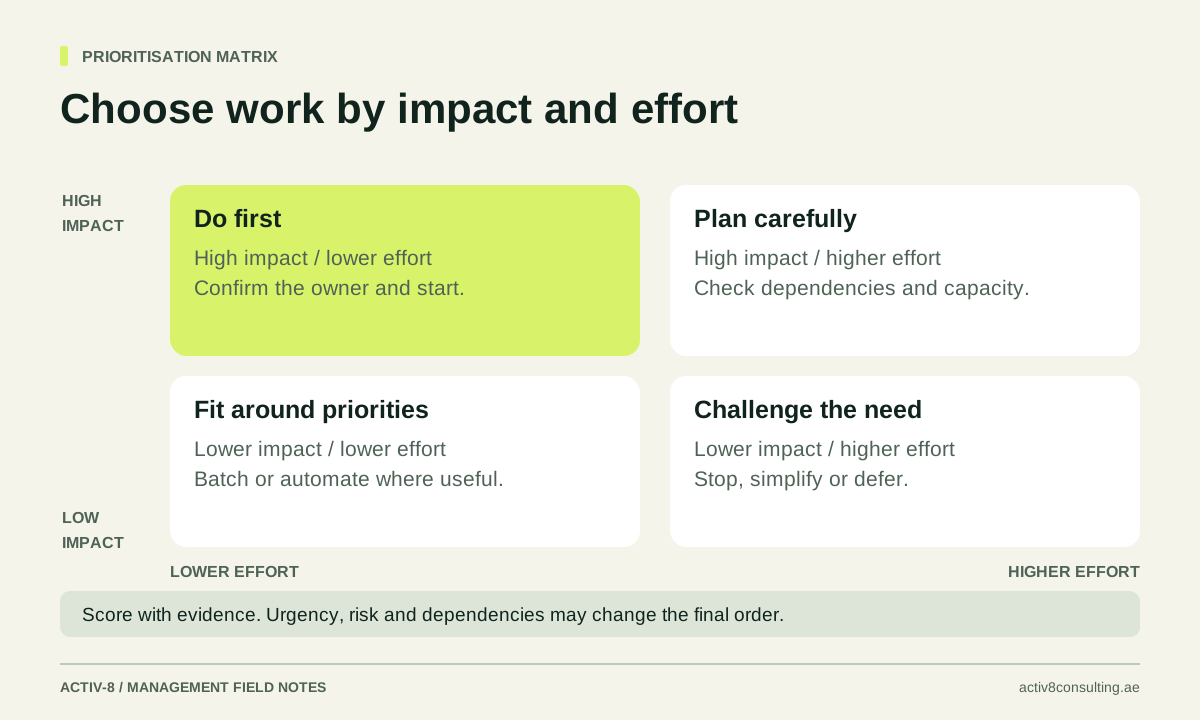
An impact-effort matrix is a simple starting point. Impact describes the expected effect on the business outcome you care about. Effort describes the resources, time and complexity required. Projects with potentially high impact and modest effort deserve attention, while high-effort projects with little relevant impact should be challenged.
Define both terms before placing initiatives. If the objective is improving on-time delivery, impact should relate to that outcome rather than general excitement or visibility. Effort should include internal work, training and ongoing maintenance as well as supplier cost. A cheap tool can still require substantial management time to implement and keep useful.
Treat the four quadrants as prompts. A high-impact, high-effort project may be strategically necessary and should be planned carefully. A low-impact, low-effort task might be batched into routine work. The matrix does not establish universal labels such as “always do” or “never do”. It helps the team explain why a project deserves scarce attention in the current context.
Add confidence and dependencies where they matter
Two projects with similar potential impact can have very different evidence behind them. One may address a measured source of rework; another may rely on an untested assumption about customer demand. Record confidence separately. This encourages the team to design a small investigation rather than pretend both benefits are equally certain.
Dependencies can change the sequence. A dashboard project may need consistent service definitions first. A new sales process may depend on clear ownership and clean records. An apparently modest enabling project can therefore be important even if its direct financial benefit is small. Show the relationship rather than inflating its impact score to make it rank higher.
Also identify risks and immovable deadlines. Some work is required to meet an actual commitment or address a serious operational exposure. Such items should pass through an explicit exception process instead of being squeezed into an ordinary benefits score. Write the reason and decision owner. That preserves transparency and prevents every sponsor from labelling their preferred project “mandatory” to avoid comparison.
Score with anchored definitions
A five-point scale is useful only when the points mean something. Define what low, medium and high impact look like for the chosen outcome. Do the same for effort and confidence. Use ranges where precise estimates are not available, and record the evidence supporting the selected category.
For example, an illustrative team reviewing quotation delays might define impact by the number of affected quotations and the expected reduction in waiting. Effort could reflect the combination of manager days, system changes and training. Confidence could distinguish an observed recurring issue from an untested idea. These definitions are tailored to the decision; they are not industry benchmarks.
If you use a weighted score, agree the weights before seeing the final ranking. Do not keep adjusting them until a favoured project wins. The downloadable worksheet provides fields for criteria, evidence, dependencies and the final decision. It deliberately leaves room for explanation because a small numerical difference rarely justifies ignoring a large difference in feasibility or uncertainty.
Work through a practical comparison
Imagine a service business considering three projects: redesign the homepage, standardise quotation approvals or replace the entire CRM. Recent records show that many suitable enquiries wait several days for an approval. The homepage may improve positioning, but there is little evidence yet that traffic quality is the main constraint. The CRM replacement would require significant migration and training.
The approval project could rank highly because it addresses a measured delay, has a defined owner and can be tested in one service category. The website work may remain worthwhile but follow a clearer offer decision. The CRM project may need a separate diagnostic to establish whether the existing system is actually the problem.
This conclusion is specific to the example. A business with a broken enquiry form or an unusable CRM could reach a different result. The point is to connect the ranking to evidence and the current constraint. Our business process improvement guide shows how to turn the chosen process issue into a bounded test with a baseline and review criteria.
Check the portfolio before approving the ranking
After scoring individual initiatives, look at the selected group as a whole. Do they compete for the same manager, data source or supplier? Do they all deliver benefits late while creating costs immediately? Does the combination support the strategy, or does it merely collect unrelated quick wins?
A business may need a mixture of immediate corrections, capability building and longer-term work. Make that balance explicit. Small improvements can relieve pressure, but they should not consume all available attention while a structural constraint remains untouched. Equally, a large transformation programme should not absorb the capacity needed to keep daily service reliable.
Use a realistic calendar to test the plan. Name the owner for each initiative, estimate their actual availability and sequence dependent work. Where capacity is insufficient, stop or defer something. The capacity planning guide can support this conversation, although the judgement about specialist skills and management attention still needs to come from the people responsible for delivery.
Keep a decision log and revisit the evidence
Before the final vote, ask each sponsor to name one piece of evidence that would lower their project’s score. If nobody can identify such evidence, the discussion may be defending preferences rather than comparing options. Record the uncertainty and consider a short research task. A small investment in better information can change the sequence more usefully than another round of scoring.
Record the final choice, the reasons, the assumptions and the review date. Include projects that were deferred and the condition that would bring them back into consideration. This reduces repeated debate and gives sponsors a clear explanation when their proposal is not selected.
At the review, compare the expected and observed effect. If a highly ranked project produces little benefit, inspect whether the problem was the estimate, execution, adoption or changed conditions. Do not use the original score to defend continuing work indefinitely. The matrix is a decision aid, and better evidence should be allowed to change the decision.
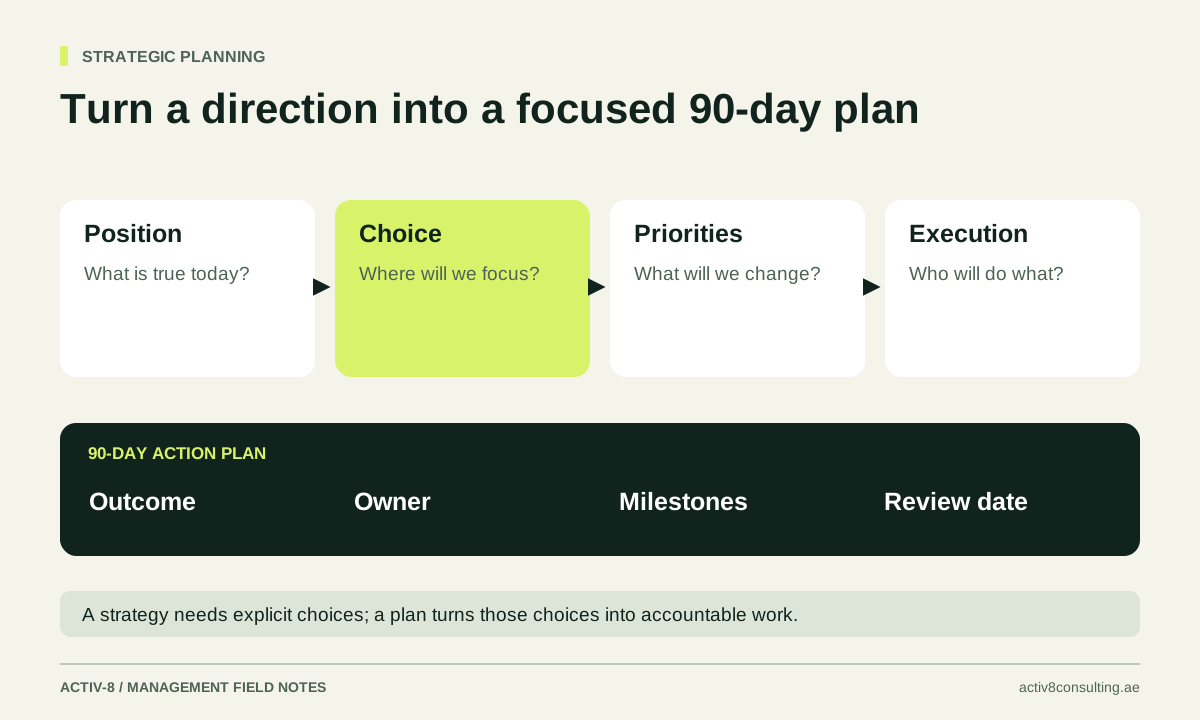
Use the worksheet below for your next planning session. Limit the initial list to initiatives the team can describe clearly enough to compare, then fill gaps before committing. Activ-8 management consultancy can help facilitate the trade-offs and connect them to the operating plan. A successful prioritisation exercise leaves the business with fewer active commitments, clear ownership and a reason for the order in which the work will happen.
PUT IT INTO PRACTICE
Priority matrix worksheet
Replace the suggested candidates with your own work. Agree what low, medium and high mean for impact and effort before rating. Consider dependencies, risk and mandatory commitments separately, then make an explicit decision. Ratings are manual; this file does not calculate a score.
Download the worksheetCSV file · Opens in Excel or Google Sheets · No sign-up required
Sources & further reading
Primary guidance behind the methods discussed. The examples, diagrams and tools in this article are original Activ-8 material.