THE STARTING POINT
Understand the contribution and customer decision behind a price before changing it.
Treat price as part of the business model
Pricing strategy connects what customers value with the economics of delivering the offer. For a small service business, the decision includes scope, service level, payment terms, packaging and the conditions under which exceptions are approved. Changing the headline price without considering those factors can produce a very different result from the one the owner expects.
Start with the commercial problem. Are suitable customers declining, is delivery contribution weak, are discounts inconsistent or is the team giving away work outside the agreed scope? Each issue suggests a different investigation. A lower price may not solve uncertainty about the service, and a higher price may not fix uncontrolled delivery effort.
The Australian Government's business guidance discusses costs, customer value and market alternatives as inputs to pricing. Those broad management principles are useful, but local tax and legal requirements must be assessed for the actual UAE business. The approach here focuses on original operational examples and a discount model, rather than prescribing a market price or a universal margin target.
Understand cost, contribution, margin and mark-up
Separate costs that vary with the sale from costs that remain fixed over the relevant period. Variable costs might include materials, subcontracted delivery or commissions. Fixed costs might include premises or a management role, although some costs change in steps as capacity grows. Use the classification that fits the decision and review it with the finance owner.
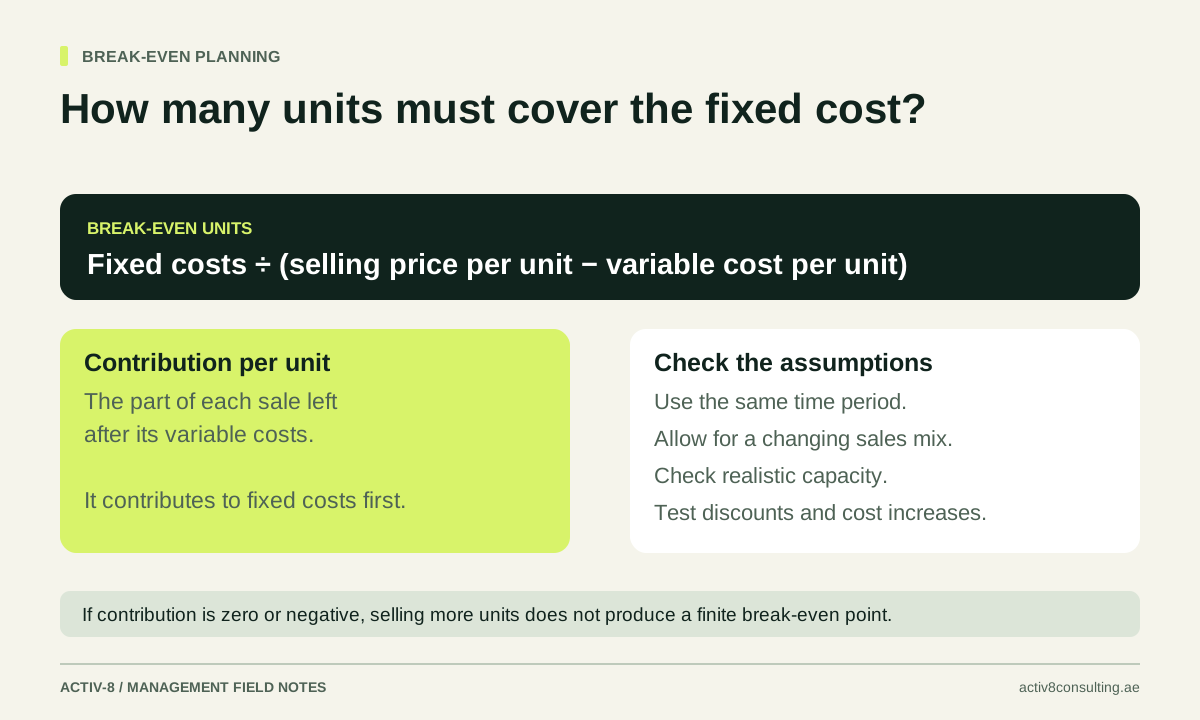
Contribution per unit is selling price less variable cost. It is the amount available to cover fixed costs and contribute to profit. Margin and mark-up use different denominators: margin divides the difference by selling price, while mark-up divides it by cost. Confusing them can produce a materially different price.
For an illustrative service priced at AED 1,000 with AED 600 of variable cost, contribution is AED 400 and contribution margin is 40%. The mark-up on that variable cost is about 66.7%. Neither figure alone establishes whether the service is profitable after overheads. The break-even guide helps connect contribution with the fixed costs the business must cover.
Compare pricing approaches without treating them as rules
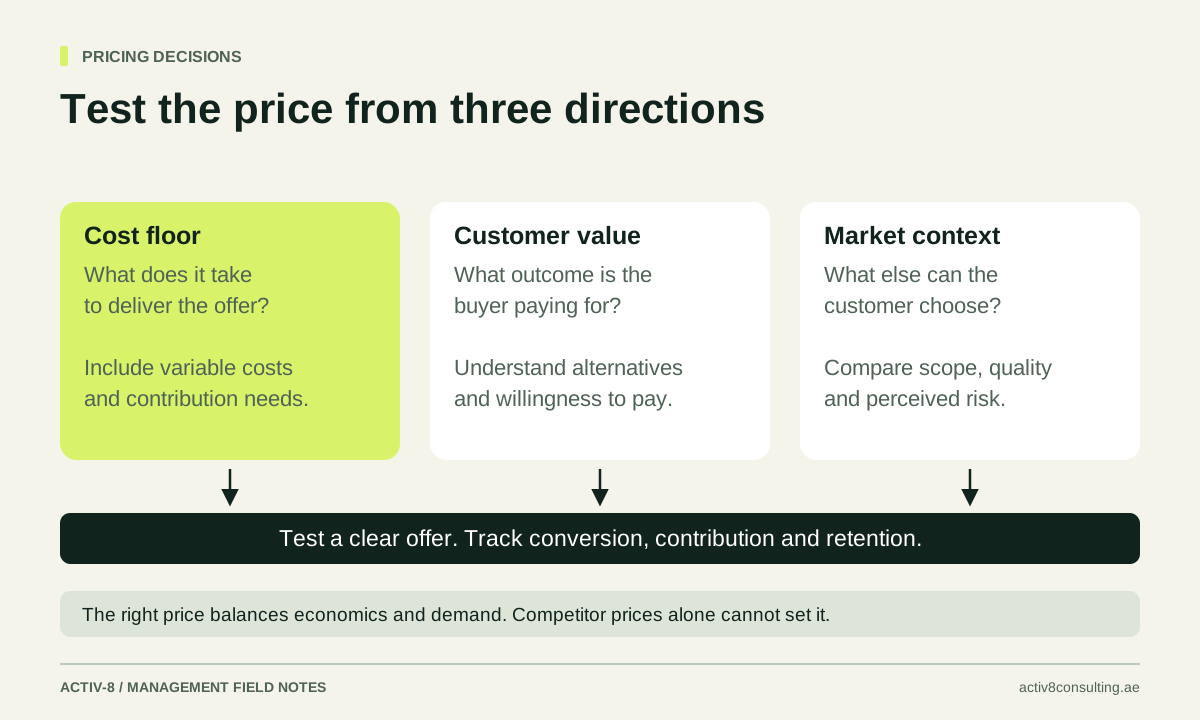
Cost-based pricing starts with the economics of delivery and adds an intended return. It can provide a useful floor for analysis, but it does not prove that customers will buy at the resulting price. If the process is inefficient, simply adding a margin to the cost may create an uncompetitive offer rather than address the underlying problem.
Market-based comparison considers alternatives available to the buyer. Compare like-for-like scope, service level, exclusions and terms. A competitor's headline price may cover a smaller outcome or rely on additional charges. Do not assume that matching the lowest visible number is necessary or commercially sensible.
Value-based thinking asks what the outcome is worth to a particular customer and why your offer is credible. It requires evidence about the customer's problem and decision, not a general claim that your service is premium. In practice, a sound pricing decision often considers all three perspectives: delivery economics, alternatives and customer value, then tests the resulting offer in a controlled way.
See why discounts can require a large volume increase
A discount reduces revenue per sale while many delivery costs remain unchanged. In the illustrative AED 1,000 service with AED 600 variable cost, a 10% discount lowers price to AED 900. Contribution falls from AED 400 to AED 300, a 25% reduction in contribution per sale.
To preserve the same total contribution, the business would need approximately 33.3% more sales: AED 400 divided by AED 300, minus one. That extra volume must be achievable and deliverable without additional fixed cost or quality problems. A 10% price reduction therefore does not mean that 10% more sales will preserve the economics.
The calculator below lets you change price, variable cost and discount to see the effect. If the discounted price is at or below variable cost, there is no finite positive volume increase that restores the original positive contribution within this simple model. The tool flags that condition rather than presenting a misleading result. Use consistent units and a comparable service scope when entering the figures.
Design packages and boundaries that customers understand
Clear packaging can reduce buying uncertainty and delivery variation. Explain the outcome, included work, assumptions, timeline and exclusions. A customer should understand what they receive and what would require a separate agreement. The team should also be able to estimate and deliver the package consistently.
Avoid adding tiers simply because three price boxes look attractive on a website. Each option should correspond to a meaningful difference in scope, support or customer need. If staff cannot explain why someone would choose one tier over another, the packaging may be creating confusion rather than useful choice.
For a service business, scope control is part of pricing. Record how additional work is identified, estimated and approved. A price can look healthy in the proposal while contribution disappears through informal extras. The SOP guide can help standardise the commercial handoff so delivery understands what was promised and who can approve a change.
Test changes with a clear hypothesis and safeguards
State what you expect the change to achieve. A new package might reduce proposal preparation and improve clarity. A price increase might improve contribution while retaining suitable demand. A discount may be intended to test a new segment. Each hypothesis requires different evidence, so choose measures before making the change.
Track conversion, contribution, service mix and delivery effort together. A higher conversion rate may be unattractive if the new customers require disproportionate support. A lower conversion rate may still produce a stronger business if the remaining work is more suitable and profitable. Interpret results in the context of sample size and other changes in demand.
Use an authorised, consistent approach that respects existing commitments and applicable requirements. Avoid casual experiments that create confusing promises or unexplained differences for customers. Record the offer, period, customer group and decision rule. Where contractual or regulatory issues arise, obtain the appropriate professional advice rather than assuming a general pricing framework answers them.
TRY IT WITH YOUR NUMBERS
Discount and contribution calculator
See how a discount changes unit contribution and the volume needed to preserve it. This assumes unchanged variable cost and service scope.
This holds variable cost and scope constant and excludes new fixed costs. Check that the additional demand exists and can be delivered. Contribution is before fixed costs.
How this calculation works
Contribution = price − variable cost. Required volume increase = (original contribution ÷ discounted contribution − 1) × 100.
Your inputs stay in this page and are not sent to Activ-8. Download the scenario if you want to keep it.
Discuss what this means for your business ↗Sources & further reading
Primary guidance behind the methods discussed. The examples, diagrams and tools in this article are original Activ-8 material.