THE STARTING POINT
Understand the customer’s experience across handoffs, not just the activities inside your business.
Map the customer's goal rather than your departments
A customer journey map describes how a person experiences a service while trying to achieve a goal. It includes what they do, the questions they need answered, the information they receive and the points where effort or uncertainty increases. It is different from an internal process map, although the two should eventually connect.
Choose a specific journey and customer group. For a service business, that might be a new commercial customer moving from recognising a problem to receiving the first completed service. A repeat customer renewing an established arrangement may follow a different journey. Combining both into one map can hide the issues that matter to each.
State the improvement question before starting. Are suitable prospects dropping out before a conversation, are customers confused after purchase or are handoffs creating repeated requests for information? A clear question helps focus research and prevents the map becoming a decorative sequence of marketing touchpoints with no connection to a business or customer decision.
Gather evidence from real experiences
Use customer interviews, enquiry records, support conversations, complaints and observed service interactions where appropriately available. Ask about a specific recent experience rather than only requesting general opinions. What was the customer trying to do, what happened next and where did they have to wait, repeat themselves or make an uncertain decision?
The GOV.UK Service Manual's experience-mapping guidance begins with users' actual experiences and recognises that different groups may need separate maps. That principle transfers usefully to a commercial service, although it does not establish anything about the behaviour of your own customers. Your map should show which observations are supported and which remain assumptions.
Do not invent customer quotations to make the diagram feel authentic. Use anonymised, authorised evidence or clearly label illustrative examples. Keep unnecessary personal information out of the working map. A small sample can identify useful questions, but explain its limits and avoid treating the loudest customer or the most recent complaint as representative of the entire market.
Define the stages in language the customer recognises
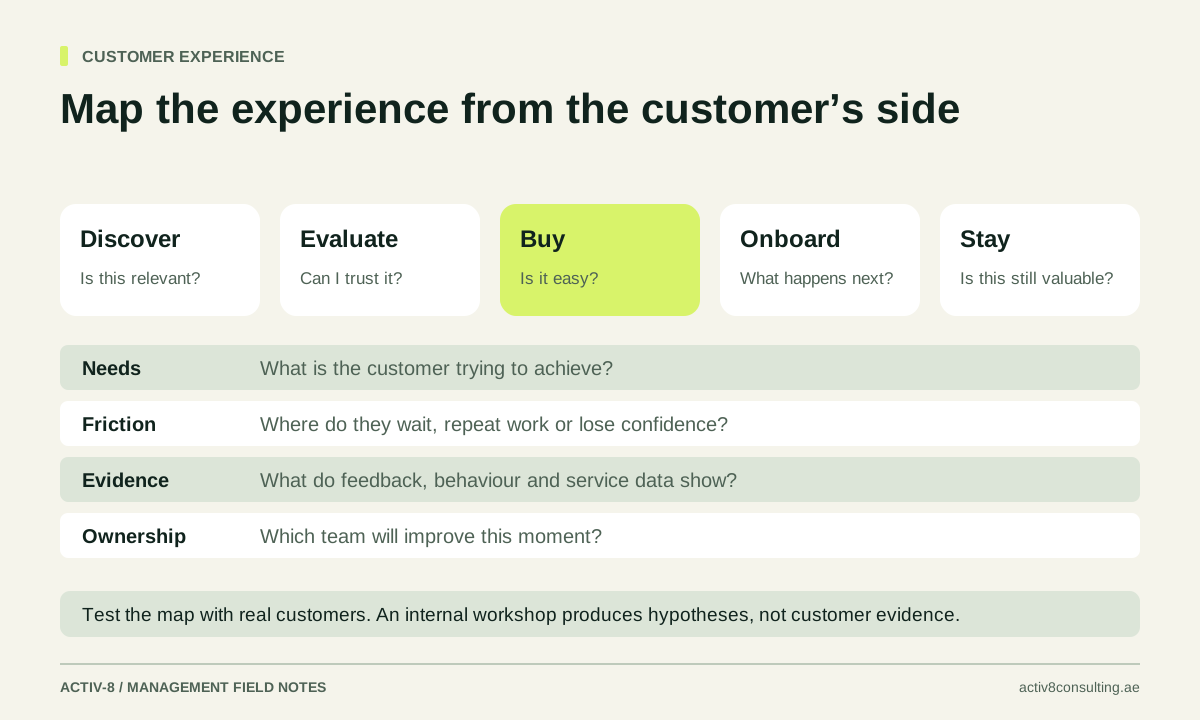
Typical stages might include recognising the need, exploring options, making contact, evaluating a proposal, agreeing the service, preparing for delivery, receiving the result and deciding whether to return. Adapt them to the actual journey. Your CRM stages may be useful internally but may not describe what the customer is trying to accomplish.
For each stage, record the customer's goal, questions, actions, channels and evidence of friction. Ask what they need to know to move forward confidently. A prospect may want to understand suitability and likely scope before completing a detailed form. A new customer may need a clear next step and a named contact more than another general welcome message.
Include the experience between visible interactions. Waiting after a proposal, uncertainty before an appointment or silence after reporting a problem can matter as much as the meeting itself. A journey map should make these gaps visible, because internal systems often record only the moments when the business takes an action.
Work through an illustrative service journey
Imagine a business owner seeking help with unreliable management reporting. They first need to decide whether the problem is data, software or management practice. They explore advisers, look for relevant evidence and want to understand what an initial engagement would involve. A clear diagnostic explanation may help more than a long list of technical capabilities.
After making contact, they may be asked for business context, current reports and the decisions they struggle to make. If several people request the same information separately, effort increases and confidence can fall. A coordinated brief and a clear explanation of why each item is needed would address a specific friction point.
During delivery, the customer wants to know what is happening, what decisions they must make and whether the work is improving the original problem. At handover, they need ownership and a maintainable process. This illustrative journey suggests improvements across marketing, qualification, project communication and operations. It is not evidence that every customer has the same preferences; the actual map must be tested with real experiences.
Connect friction to the internal process
Once a customer problem is visible, trace the internal cause. Repeated information requests may come from disconnected records, unclear ownership or different teams using incompatible definitions. Slow responses may reflect capacity or approval rules. A friendlier message alone may not resolve the underlying experience.
Use a business process map to connect the customer's journey with the work behind it. Identify the role responsible for each handoff and the information required. This creates a route from an experience observation to an operational change that somebody can own.
Distinguish symptoms from causes. A customer saying that communication was poor could mean too little information, inconsistent information, an unexpected delay or unclear responsibility. Ask which specific event created the problem before designing a solution. Otherwise the business may respond with more messages while leaving the uncertainty that caused the complaint unchanged.
Prioritise improvements using impact and evidence
Choose improvements based on the importance of the customer goal, the severity and frequency of friction, the evidence available and the effort required. Do not prioritise only the most visible touchpoint. A modest improvement in a repeated handoff may matter more than a complete redesign of a stage that already works well.
For each proposed change, state the hypothesis. A clearer proposal scope might reduce clarification rounds and help suitable customers decide sooner. A named onboarding owner might reduce repeated questions and missed preparation. Define the measure and the conditions that would indicate the change is helping.
Use the prioritisation matrix where several initiatives compete for the same resources. Include dependencies and operational capacity. A promise of faster service is not an improvement if the business cannot reliably deliver it. Align the customer-facing message with the actual process and support available before increasing expectations.
Measure the experience without reducing it to one score
Useful measures can include response time, repeated contacts, completion of a customer task, complaints, first-time resolution and retention. The right combination depends on the journey. A satisfaction score may provide a signal, but it should be interpreted alongside behaviour and specific feedback.
Show the denominator and sample period for rates. A small number of responses can create large swings, and people who answer a survey may differ from those who do not. Separate different customer groups where the journeys or expectations differ. Avoid declaring that an experience has improved based only on a single positive comment after a change.
Review the business and customer outcomes together. Faster onboarding may help the customer and reduce internal chasing, but only if accuracy and suitability remain sound. A higher enquiry conversion rate is not automatically desirable if it brings work the company cannot serve well. The map should support a better relationship and a more dependable service, rather than optimise one isolated metric.
Keep the map alive through service changes
Assign an owner, date and evidence references to the map. Revisit it when the offer, customer group, system or delivery model changes. Use new complaints and successful experiences to test whether the map still describes reality. It should remain a working tool rather than a workshop output stored and forgotten.
Start with one important journey and a few well-chosen customer conversations. Connect the findings to a practical change, test it and review the result. Activ-8 sales and customer experience consultancy can help organise the research and translate it into improvements across the commercial and delivery process. Bring the points where customers repeatedly hesitate, chase or express confusion; those are useful starting places for understanding the experience more clearly.
Sources & further reading
Primary guidance behind the methods discussed. The examples, diagrams and tools in this article are original Activ-8 material.
Put the thinking into practice.
Explore sales and customer experience Discuss your business with Mark