THE STARTING POINT
Delegation needs decision boundaries, access to information and a clear escalation rule.
Delegate a decision, not just a task
A delegation matrix makes it clear who can make which decisions, within what boundaries and when an issue should escalate. It is particularly useful in an owner-led business where managers have responsibility but still seek approval for routine matters. The aim is to move decisions closer to the work while keeping appropriate control and visibility.
Start with a repeated decision that regularly reaches the owner: approving a standard quotation, resolving a small service issue, scheduling staff or authorising a routine purchase. Describe the decision and the information required. “Manage operations” is too broad to delegate clearly; approving a defined exception within agreed limits is much more practical.
Delegation does not mean withdrawing support. The manager needs authority, access to information, the relevant skill and a route for unusual cases. If any of those are missing, the owner may receive the same question repeatedly despite having said “you can decide”. The matrix should make those conditions explicit rather than assuming confidence will appear automatically.
List the decisions that create repeated friction
Review a recent week of owner or senior-manager interventions. Group the questions by type and note their frequency, impact and reason for escalation. Some may be genuinely significant decisions. Others may recur because the rule is unclear, information is inaccessible or managers fear being criticised for a reasonable judgement.
Separate those causes before redesigning authority. If a manager lacks reliable cost information, raising their approval limit may not solve the problem. If the rule is clear but exceptions are frequent, the standard offer or process may need improvement. The business diagnostic guide helps examine these connections rather than treating every bottleneck as a personal reluctance to delegate.
Prioritise decisions that are frequent, bounded and supported by information. They provide a manageable starting point. Avoid beginning with the most consequential or unusual decision simply to demonstrate trust. A staged approach allows the manager and owner to learn whether the boundaries, information and review method are sufficient before expanding the authority further.
Define boundaries in more than monetary terms
Financial limits are useful, but they rarely describe the whole risk. A small discount may be acceptable on a standard service but problematic when combined with unusual payment terms, a demanding deadline or an open-ended scope. Include the conditions that matter to the business, rather than relying on a single currency threshold.
An illustrative quotation rule might allow a manager to approve a standard package within an authorised price range, provided delivery capacity is confirmed and the usual terms remain unchanged. Non-standard scope, exceptional commitments or conflicts with the approved margin rule would escalate. The actual thresholds must be set by your authorised leadership and relevant professional advisers, not copied from this example.
State what information must be checked and what record must be kept. The matrix should also identify decisions that are outside the delegated role entirely. This is especially important where legal, financial, employment or technical authority has specific requirements. General management delegation should support existing obligations rather than appear to override them through an informal worksheet.
Give the manager a usable escalation route
Describe the trigger for escalation, the person who receives it and the information needed. A good escalation includes the situation, options, recommendation, relevant evidence and time available. This develops judgement and reduces the need for the senior manager to reconstruct the problem from a brief message saying “what should I do?”
Agree how urgent cases are handled when the usual approver is unavailable. Name a substitute or a safe holding action within the person's authority. If every exception must wait for the founder to return from a meeting, the process remains fragile even if routine decisions have been delegated successfully.
Distinguish asking for advice from transferring the decision. A manager may consult a colleague while retaining authority and accountability. Make that distinction explicit so collaboration does not become an invisible approval chain. The SOP guide can help document the supporting process, while the delegation matrix stays focused on who decides and under what conditions.
Practise with realistic examples before rollout
Use several recent cases to test the matrix. Ask the manager to identify the decision, apply the boundaries and explain whether they would decide or escalate. Include a normal case, a borderline case and an exception. Differences in interpretation reveal where the rule needs clarification before it becomes part of daily work.
Discuss the reasoning rather than only whether the answer matches the owner's instinct. If two reasonable interpretations lead to different outcomes, improve the rule or the information available. A matrix cannot anticipate every situation, so the review should also build an understanding of the commercial principles behind the boundaries.
Introduce the delegation in a defined area and review a sample of decisions. Avoid reversing decisions casually after the manager has acted within the agreed rules. If the rule needs to change, explain why and update it prospectively where appropriate. Unpredictable intervention can teach managers that seeking approval is safer than using the authority they have been given.
PUT IT INTO PRACTICE
Delegation matrix worksheet
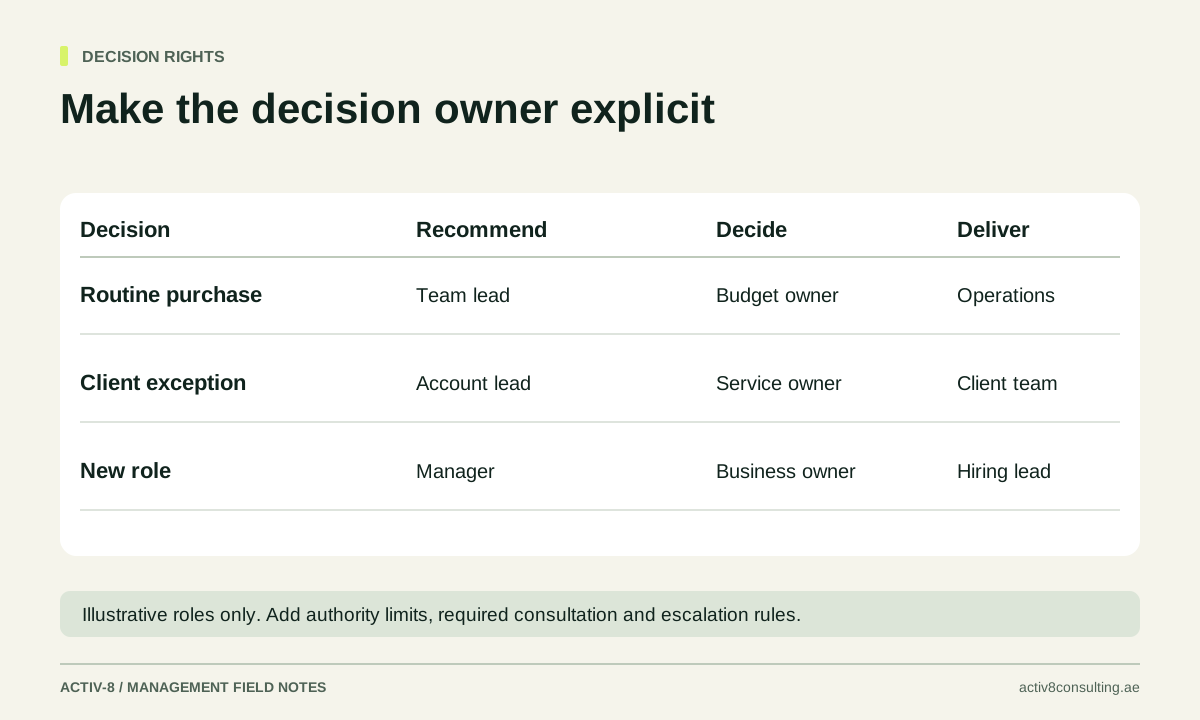
For each recurring decision, name one accountable decision owner, distinguish who recommends and who delivers, and write the authority limit. Replace role placeholders with named roles appropriate to your business. These are decision prompts; no authority is granted by this template.
Download the worksheetCSV file · Opens in Excel or Google Sheets · No sign-up required
Sources & further reading
Primary guidance behind the methods discussed. The examples, diagrams and tools in this article are original Activ-8 material.