THE STARTING POINT
Choose a growth route the business can serve profitably and fund through its cash cycle.
Define growth in terms of a stronger business
A business growth strategy explains how the company will win more valuable work and build the ability to deliver it. Revenue is part of the picture, but growth that weakens contribution, cash or customer experience can leave an owner with a larger and more fragile business. Start by defining what successful growth would improve.
Possible outcomes include more contribution from the existing customer base, a more predictable recurring service, less dependence on one customer or greater use of available capacity. These goals suggest different routes. A company with spare delivery capacity needs a different plan from one that is already missing deadlines and relies on the founder to rescue difficult jobs.
Before choosing a route, review customer economics, delivery constraints and cash timing. Identify which offers create repeatable value and which create disproportionate complexity. Our business diagnostic checklist helps establish that baseline. The growth discussion becomes more useful when the team can distinguish a lack of demand from a weak offer, inconsistent sales execution or insufficient operational capacity.
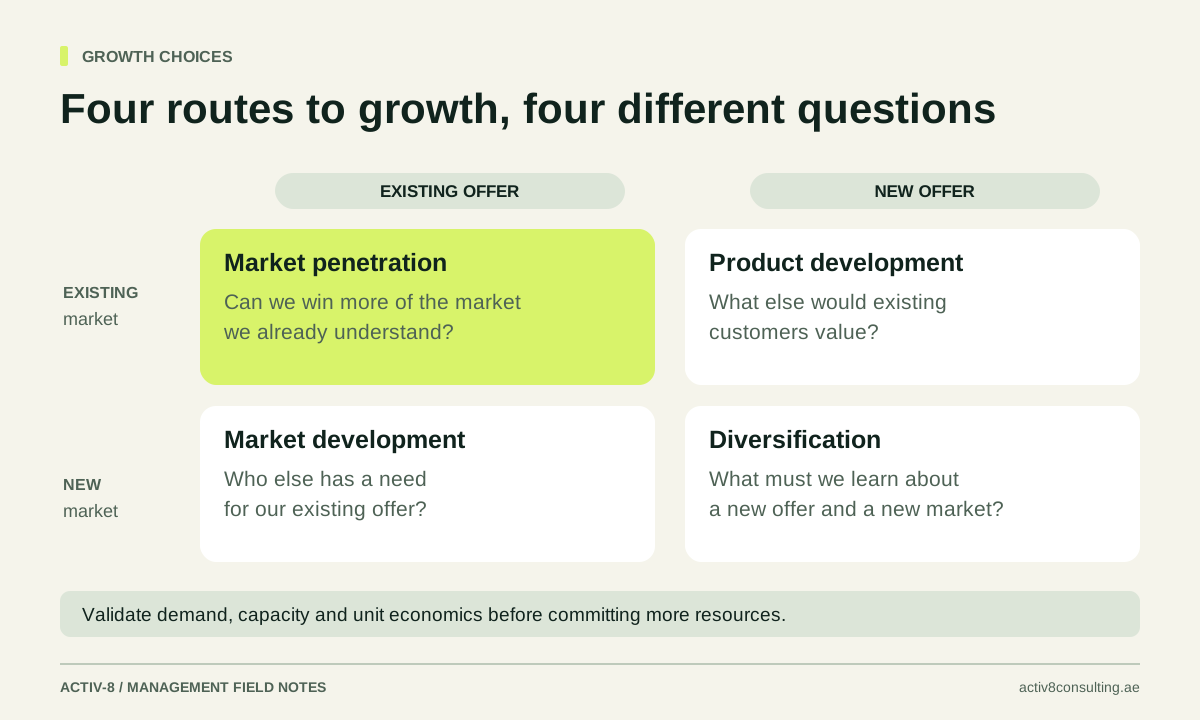
Compare the four broad routes to growth
One route is selling more of an existing offer to customers you already understand. That might involve better retention, more reliable follow-up, a clearer package or reaching more similar buyers. It can still require meaningful change, but the business has some evidence about the offer and the customer problem.
A second route takes an existing offer to a new customer group or market. A third develops a new offer for current customers. A fourth combines a new offer with a new market. These categories are a thinking aid, not a ranking of guaranteed safety. A familiar market can still be unprofitable, and a new offer can succeed when the underlying evidence is strong.
For each route, list what you know and what you must learn. Can existing customers explain a repeated unmet need? Will a new segment buy through the same channel? Does delivery require different skills or service levels? The more assumptions the route introduces, the more valuable a bounded test becomes before committing significant capital or permanent capacity.
Start with customer and offer evidence
Review who buys, who stays, who refers and who creates profitable work. Do not assume that the largest account is the best model for growth. It may receive extensive discounts, customised reporting or unusually long payment terms. Compare contribution and management effort alongside headline sales.
Talk to customers about the job they need done, the alternatives considered and the conditions that make purchase worthwhile. Look for patterns across several conversations and actual buying behaviour. Avoid treating a polite expression of interest as a forecast sale. Where practical, test a clear offer with scope, timing and price so the response is more informative.
An illustrative business-support firm might find that clients repeatedly request a monthly operating review after completing an initial project. That could support a recurring service, but the firm must still test the required preparation, meeting time and follow-up. A service that sounds attractive can become difficult to scale if every client expects a different set of reports and unlimited access to senior staff.
Model contribution before projecting revenue
Estimate the additional revenue and the costs that increase with it. Include delivery effort, materials, subcontractors, commissions, support and likely rework. Then identify additional fixed or step costs, such as another manager or a new system. A growth model should show when these costs appear, not spread them invisibly across an optimistic annual total.
Suppose an illustrative service produces AED 4,000 of revenue and AED 2,500 of variable delivery cost per engagement. Contribution is AED 1,500. Twenty additional engagements would contribute AED 30,000 before new fixed costs. If serving them requires AED 25,000 of extra monthly overhead, the apparent AED 80,000 revenue increase leaves only AED 5,000 before other effects.
Check whether price, service mix or delivery efficiency could improve the economics. Do not assume these improvements will happen automatically. The break-even calculator helps explore the sales volume needed to cover additional fixed cost, while the pricing strategy guide explains why discounting can require a larger volume increase than expected to preserve contribution.
Check capacity and the cash cycle
Map the work required to deliver the additional sales. Identify the bottleneck skill, approval or resource, rather than adding all staff hours together and assuming they are interchangeable. Include onboarding, quality checks, management time and exceptions. The capacity planning calculator provides a starting estimate, but a real delivery schedule is needed for the final decision.
Then consider cash. Will deposits cover initial costs? When are staff, suppliers and subcontractors paid? When do customers actually settle invoices? A growing business can experience increasing cash pressure when it funds delivery well before collection. Model the timing of receipts and payments rather than relying only on the profit forecast.
Build scenarios around slower collections, delayed hiring and uneven demand. If the downside case leaves little room for error, consider a smaller launch, staged commitments or a different commercial structure. Decisions about finance, tax and contractual terms should be reviewed with the appropriate advisers. The strategy should expose these requirements early, while there is still room to change the growth route.
Test one growth hypothesis at a time
Write the hypothesis in a way that can be challenged. For example: a defined monthly review service will appeal to existing project clients, can be delivered within a specified number of hours and will achieve a minimum contribution. Set the test boundary, sample, owner and review date before starting.
Measure demand and delivery together. Track how many suitable customers receive the offer, how many buy, why others decline and what the service actually costs to deliver. If the pilot wins sales but consumes twice the expected senior time, it has not yet established a scalable model. If it delivers efficiently but buyers do not value it, investigate the offer and customer segment.
Agree what would justify expansion, revision or stopping. This reduces the temptation to interpret any positive feedback as proof. Keep the first test small enough to learn without overwhelming the existing business, but representative enough to include normal exceptions. A pilot involving only the easiest customer and the most experienced employee can give a misleading picture of repeatable performance.
Build the operating plan around the chosen route
Before scaling, write down the conditions that would cause you to slow the plan. These could include service delays, weak contribution, collection problems or a pilot assumption proving wrong. Agreeing those conditions in advance makes it easier to respond to evidence without treating every adjustment as a loss of confidence in the business.
Once a route has sufficient evidence, translate it into a plan across sales, delivery, people, systems and cash. Give each workstream an owner and identify dependencies. Marketing should know what the business can credibly promise; operations should know the expected demand and service mix; finance should know the timing of commitments and receipts.
Review progress using a small set of connected measures. Suitable measures might include qualified demand, conversion, contribution per engagement, delivery reliability and cash collection. Keep definitions stable and compare the results with the assumptions that justified the plan. Explain whether a variance reflects volume, price, mix, cost or timing before deciding how to respond.
Growth is a sequence of commercial and operational decisions, not simply a larger target. If you need support choosing the route and making the business ready to deliver it, explore Activ-8 management consultancy. Bring the opportunity you are considering, the evidence available and the constraint that could prevent it working. A useful strategy turns ambition into a testable, funded and manageable path forward.
Sources & further reading
Primary guidance behind the methods discussed. The examples, diagrams and tools in this article are original Activ-8 material.