THE STARTING POINT
The business case is only as strong as its assumptions about adoption, timing and cashable benefits.
Use the model to challenge the investment case
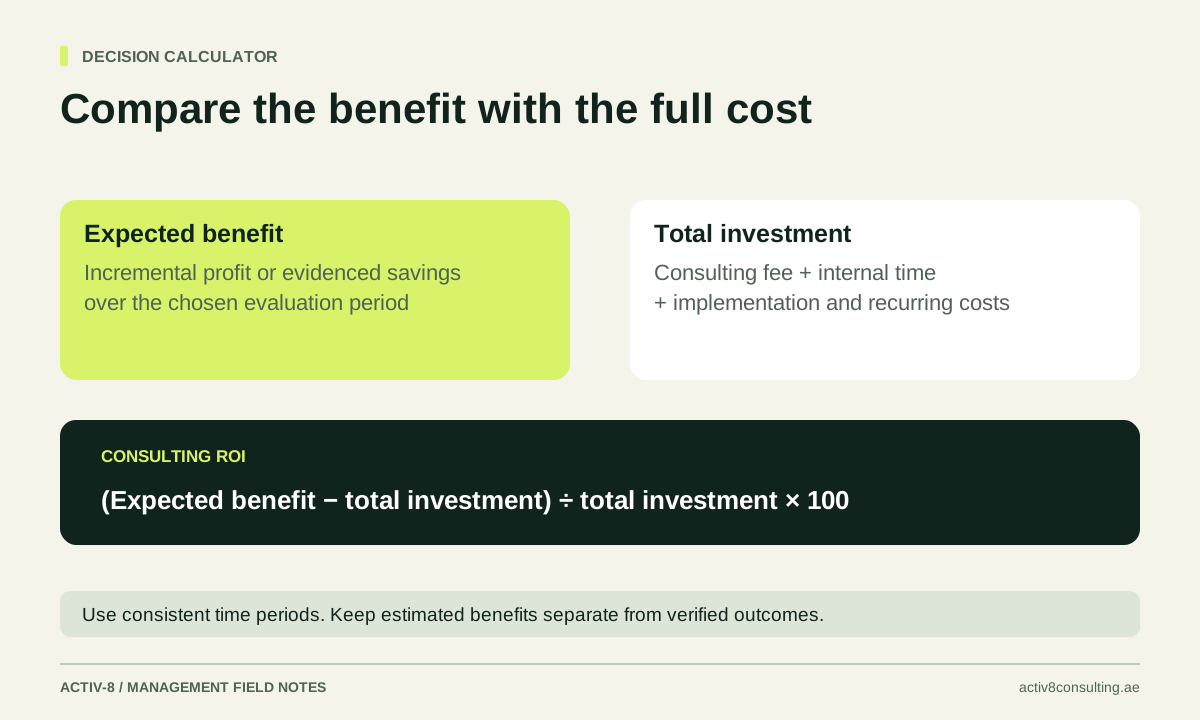
A consulting ROI calculator helps compare an engagement's expected benefits with its full cost. It is most useful before committing a budget, when assumptions can still be tested and the scope can change. The result is a planning estimate. It does not prove that a consultant will produce the benefit or that every improvement in the business will be attributable to the engagement.
Start by describing the decision. Perhaps a business is considering a project to reduce order-processing errors, improve quotation turnaround or establish reliable management reporting. Define what will change, who will implement it and how long you will allow for the benefits to appear. A percentage without that context can be reassuring and still be commercially meaningless.
The calculator below uses a simple, undiscounted model over a chosen number of months. It separates initial investment, monthly gross financial benefit, adoption and recurring cost. It is intended for operational planning, not a valuation, financing recommendation or replacement for professional financial advice. For a material investment, have the assumptions and accounting treatment reviewed appropriately.
Calculate the complete investment
Initial investment includes the consultancy fee, internal implementation time and other setup costs. Depending on the project, these could include data preparation, process documentation, training, integration or temporary support. Include work your team must do even when it is not separately invoiced, because that capacity cannot simultaneously be used elsewhere.
Recurring costs include additional software, maintenance, outsourced support and any continuing advisory fee during the evaluation period. Do not include an existing cost unless the project changes it, or unless your purpose is to compare the entire operating model. Be consistent about which question the calculation answers.
Separate cash costs from opportunity cost in your notes. AED 5,000 of existing manager time is relevant to the investment decision, but it may not create an extra bank payment. Likewise, if a tool replaces another subscription, enter the net additional recurring cost only after checking the cancellation timing. Keep all monetary inputs on a consistent tax basis and use the same currency throughout the model.
Distinguish the different kinds of benefit
Cashable savings reduce spending that the business would otherwise incur. Examples might include ending an unnecessary subscription or avoiding external rework charges. They need a clear baseline and evidence that the cost will actually disappear. A lower theoretical cost per transaction is not automatically a reduction in the next month's bank payments.
Capacity released means the team needs fewer hours for the same work. This can be valuable even without a direct cash saving, but explain how the capacity will be used. It may absorb growth, reduce overtime or improve service. Do not value the hours as salary savings unless staffing or paid hours genuinely change in a justified, authorised way.
Additional revenue should be converted into incremental contribution before entering the calculator. If extra sales require materials, delivery labour or commissions, those costs reduce the benefit. Faster cash collection improves timing and liquidity, but it is not the same as new profit. Keep these categories separate so the model does not count the same business improvement twice.
Work through an illustrative AED example
Suppose a business is considering AED 30,000 of initial consulting and implementation cost. It estimates a potential AED 6,000 monthly financial benefit at full adoption and AED 500 monthly running cost. The owner expects 75% of the potential benefit to be realised during a twelve-month evaluation period. These are hypothetical inputs, not a typical return or an Activ-8 performance claim.
Adjusted monthly gross benefit is AED 4,500: AED 6,000 multiplied by 75%. Over twelve months that is AED 54,000. Recurring costs total AED 6,000, so total investment is AED 36,000. Net benefit is AED 18,000, and ROI is 50%: net benefit divided by total investment, multiplied by one hundred.
For simple payback, monthly net benefit is AED 4,000 after the recurring cost. Dividing the AED 30,000 initial investment by AED 4,000 gives 7.5 months after benefits start. If implementation takes three months before any benefit appears, calendar payback is later. The calculator's simple payback output therefore needs to be read alongside the implementation schedule, not as a promise about a date.
Stress-test adoption, timing and the baseline
Reduce adoption before increasing the benefit assumption. What happens if only half the staff use the new process consistently? What if the process works for standard cases but exceptions still consume most of the time? A small pilot can provide better evidence than a confident forecast based on ideal conditions.
In the example, changing adoption to 40% reduces monthly gross benefit to AED 2,400. After the AED 500 running cost, monthly net benefit is AED 1,900. Twelve months produce AED 28,800 of gross benefit against AED 36,000 of total investment, giving a negative return over the period. The same project can therefore look attractive or unattractive depending on an assumption that deserves direct investigation.
Check the starting point as carefully as the improvement estimate. If the baseline contains an unusually bad month, the apparent benefit may be exaggerated. Use representative work, include error correction and compare like-for-like volumes. Where uncertainty is large, show a downside, central and upside case with reasons for the differences. Do not average them together and present the answer as a measured outcome.
Avoid double counting and false precision
Imagine a process improvement releases forty hours each month. The sales plan assumes those hours will be used to deliver additional customer work. Counting the full value of the hours as a cost saving and then adding the entire contribution from that extra work may count the same capacity twice. Decide which benefit is actually expected and document the route from operational change to financial outcome.
Other overlaps are less obvious. A reduction in refunds may already be included in improved contribution per order. Lower rework costs may already appear in the revised variable cost. Use a benefits register with one line per benefit, its calculation, evidence source and owner. This makes it easier to spot duplication before the total becomes persuasive.
Not every benefit should be monetised. Better decisions, clearer accountability and reduced disruption can be important, but an invented monetary value weakens the case. Describe the expected operational effect and the evidence you will collect. If the project is required for a contractual or regulatory reason, assess that requirement separately rather than forcing it through a simplistic ROI threshold.
Turn the estimate into a benefits review
For each benefit, add one sentence explaining the causal link: this change removes this cost or enables this contribution because of this observed behaviour. If that sentence relies on several untested assumptions, identify the cheapest useful test before expanding the engagement. This keeps the business case connected to a real mechanism rather than an attractive percentage.
Before the project begins, record the baseline, assumptions, expected timing and owner for each benefit. Agree what will be measured during the pilot and after implementation. Keep the original forecast visible so that later changes can be understood. A revised forecast may be entirely sensible, but it should not quietly replace the original investment case.
Review adoption and outcomes together. If the tool is being used but the expected benefit is absent, investigate the process or original hypothesis. If the tool is not being used, resolve access, training, workload or management expectations. A positive spreadsheet result is not a substitute for these observations.
Use the calculator to prepare questions for an adviser and compare a smaller pilot with a larger commitment. The consultancy fees guide helps define the cost side, while Activ-8's management consultancy service explains the support available. Share your assumptions and the decision you are considering; the useful conversation is about whether the business case is credible and how to test it.
TRY IT WITH YOUR NUMBERS
Consulting ROI calculator
Estimate the return over your chosen period. Replace these illustrative inputs with your own assumptions.
Undiscounted planning estimate. Payback assumes steady monthly benefit after implementation; add any delay before benefits start. Verify cashable savings separately from capacity value.
How this calculation works
ROI = (gross benefit over period − total investment) ÷ total investment × 100. Simple payback = initial investment ÷ positive monthly net benefit.
Your inputs stay in this page and are not sent to Activ-8. Download the scenario if you want to keep it.
Discuss what this means for your business ↗Sources & further reading
Primary guidance behind the methods discussed. The examples, diagrams and tools in this article are original Activ-8 material.