THE STARTING POINT
Compare the proposed work and the people doing it against your actual problem.
Write the buying brief before building a shortlist
Choosing a management consultant becomes easier when you describe the decision you need help with. “We want to grow” leaves almost unlimited room for interpretation. “We need to choose which customer segment to prioritise and translate that choice into a funded delivery plan” gives a prospective adviser something concrete to assess.
Write a short brief covering the business model, current problem, evidence, desired outcome and constraints. Explain what has already been tried. Include the people who will need to participate, the systems involved and the time available for implementation. You can acknowledge uncertainty. A brief may legitimately ask the consultant to diagnose the cause before recommending a solution.
For a UAE business, clarify the practical delivery arrangements as well. Does the work require on-site observation, remote workshops, Arabic-language materials or coordination across emirates and time zones? These requirements should come from the work, rather than assumptions about a consultant's office address. Share the same brief with each shortlisted adviser so you are comparing responses to the same assignment.
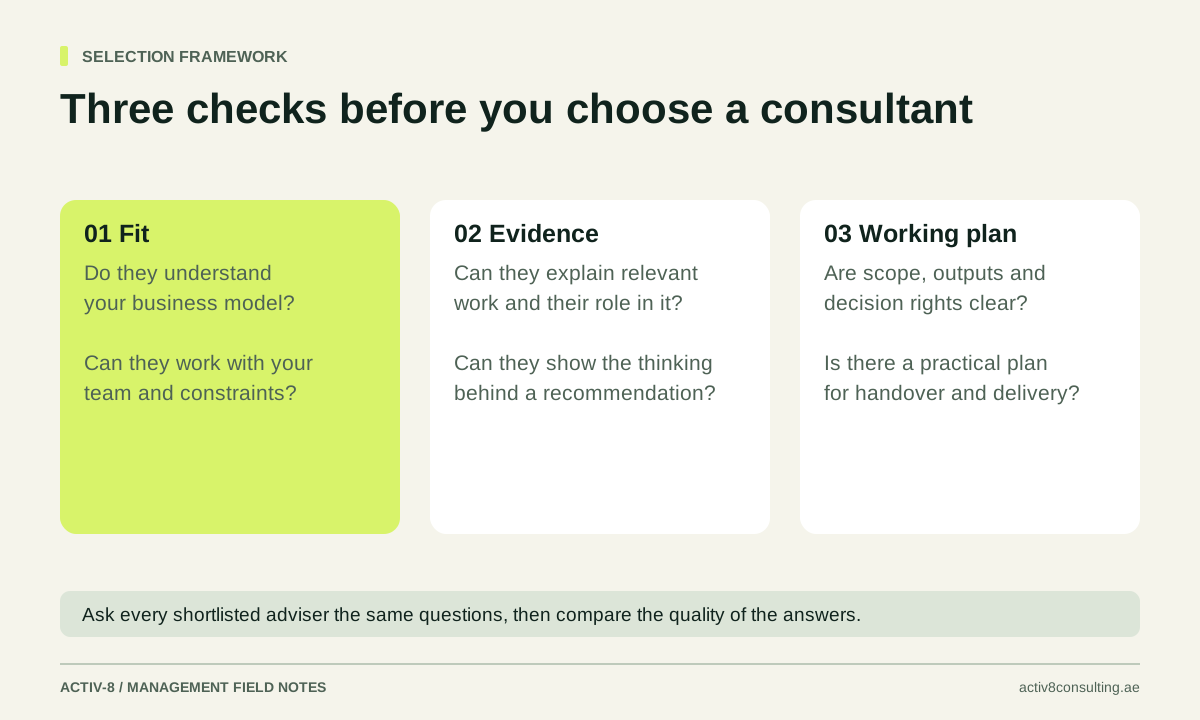
Test relevant experience with specific questions
Relevant experience means understanding the shape of your problem, not merely displaying familiar industry logos. A consultant who has improved a similar approval process or helped an owner delegate operational decisions may be more useful than one whose only connection is having served a company in the same sector.
Ask for an example of comparable work and the consultant's personal contribution. What was the starting situation? Which information changed the diagnosis? What did the team actually implement? What was measured afterwards? Respect confidentiality: a sensible explanation can omit client identities and sensitive figures while still showing how the adviser thinks.
Be cautious with outcome claims that omit the baseline, time period or other changes happening in the business. A claimed revenue increase does not establish that consulting caused it. Ask what the adviser would do differently next time. The answer can reveal more about judgement than a polished success story. References, where available and authorised, are useful for understanding working style and follow-through, but should complement your own assessment rather than replace it.
Meet the people who will deliver the work
The person selling the engagement may not be the person doing it. Ask who will lead the assignment, who will complete analysis and who will attend working sessions. Establish the expected senior involvement and how substitutions will be handled. A proposal should not leave you guessing whether access to the experienced adviser is included or separately charged.
Use a working discussion to test collaboration. Present a real but appropriately anonymised problem and ask how they would investigate it. You are not requesting free completion of the project. You are checking whether they listen, distinguish evidence from opinion and adapt the approach to your company's scale.
Look for useful challenge. An adviser who immediately agrees with every diagnosis may be avoiding the difficult part of the work. Equally, someone who dismisses your team's knowledge before understanding the context can create resistance. The right relationship allows disagreement, clear decisions and respectful communication. Consider who inside the business will work with the consultant most often and include that person in the selection conversation.
Compare proposals on scope, assumptions and ownership
Create a comparison table before discussing price. Record the problem addressed, deliverables, exclusions, number and purpose of working sessions, implementation support and handover. Then list what each proposal assumes about your data, staff availability and decision speed. Two proposals with the same title may cover very different work.
For example, one strategy proposal may include research and a presentation. Another may include the research, a facilitated leadership decision, a 90-day action plan and two implementation reviews. Neither is inherently the correct purchase. The distinction matters because the cheaper proposal may leave significant work for your team, while the larger one may contain support you do not need.
Ask how changes to scope are agreed. A useful process identifies the proposed addition, its reason, cost and timing before work expands. Also establish acceptance criteria for deliverables. An operating model should be understandable and usable by the managers who inherit it. A report being emailed to the owner is not sufficient evidence that this has happened.
Use a scorecard without pretending it removes judgement
A simple scorecard helps stop a charismatic presentation dominating the decision. Choose criteria before scoring proposals. Possible criteria include understanding of the problem, relevant evidence, quality of the proposed method, delivery capability, knowledge transfer and total cost. Weight them according to the assignment, then record the reason for each score.
An illustrative weighting could give problem understanding and delivery approach more weight than presentation style or brand familiarity. This is a buying aid, not a universal benchmark. If data security, language capability or a particular professional qualification is essential, treat it as a pass-or-fail requirement before ranking the remaining candidates.
Have two people score independently where practical, then discuss the differences. A large disagreement often exposes an assumption worth checking with the adviser. Do not let a decimal point create false precision. A proposal that wins narrowly but depends on an unavailable manager may be less feasible than the runner-up. The prioritisation matrix guide explains how to combine structured scoring with dependencies and judgement.
Discuss fees and the working agreement in detail
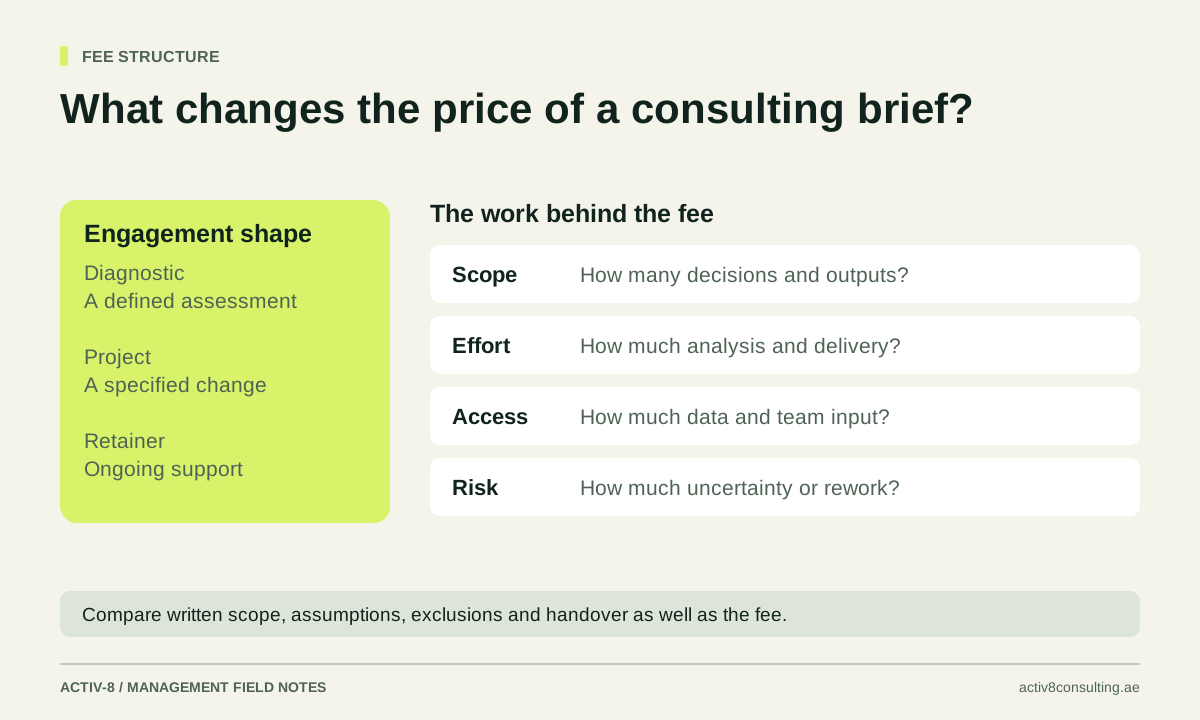
Ask for the full commercial picture: fees, payment milestones, travel, software, research costs, taxes where applicable and any ongoing support. Understand whether you are buying a fixed outcome, a defined allocation of time or continuing access to advice. Our consultancy fees guide sets out the differences and a method for comparing the complete cost.
The working agreement should clarify confidentiality, access to business information, ownership or permitted use of deliverables, termination, change control and responsibilities on both sides. Use qualified legal advice where the terms warrant it. Do not assume a generic document addresses your particular information, supplier or cross-border requirements.
Ask how information will be collected and shared. Start with the minimum necessary access. Agree who can see sensitive commercial records, whether subcontractors are involved and what happens to information when the engagement ends. These are normal delivery questions. They also reveal whether the consultant has considered the practical obligations that come with working inside someone else's business.
Make the first phase testable
Keep a short selection record. Note which proposal you chose, the main reasons, unresolved assumptions and the evidence you expect at the first review. This gives the sponsor a practical reference when the engagement starts and prevents the buying rationale being lost during handover to the delivery team.
When uncertainty is high, a bounded first phase can be a better buying decision than a large open-ended commitment. The phase might establish a baseline, map the critical process and recommend options. Agree the decision you will make at its end: continue, change scope, pause or complete the work internally.
Define the evidence you expect. A diagnostic should explain findings, limitations and priorities. A pilot should show whether the process works with representative cases, including exceptions. A reporting project should demonstrate that the team can reconcile the numbers and use them in an actual meeting. The first milestone should therefore test usefulness as well as document delivery.
Before appointing anyone, check that you have an internal sponsor, access to the necessary people and enough capacity to act on the findings. Even an excellent adviser cannot make a decision that the owner repeatedly defers. A well-chosen consultant adds independent thinking and implementation support to an engaged business. To discuss whether Activ-8 fits your requirement, review our management consultancy approach and send a brief describing the outcome, timing and budget you have in mind.