THE STARTING POINT
Forecast when money is expected to move, reconcile weekly and keep uncertainty visible.
Forecast the movement of money, not just sales
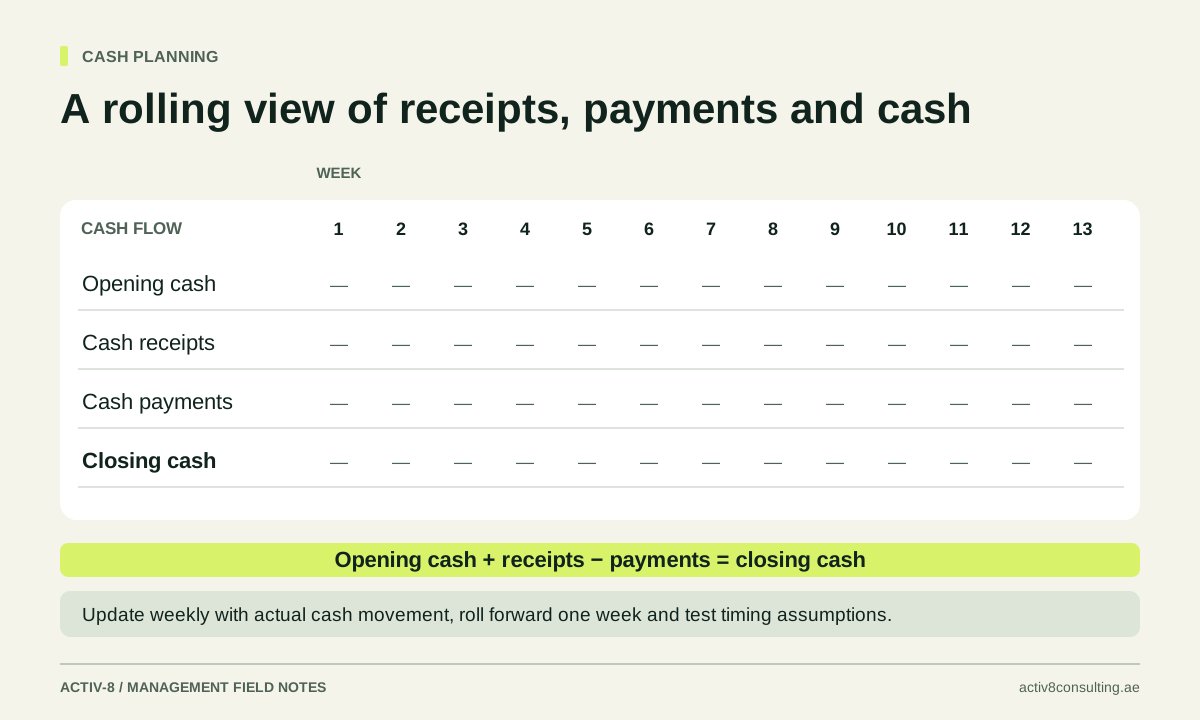
A 13-week cash-flow forecast estimates the money expected to enter and leave the business each week. It helps an owner see the timing of cash pressure, prepare collection actions and plan commitments. The thirteen-week horizon is a practical short-term planning window, not a rule that suits every business or a guarantee that the forecast will be accurate.
The central calculation is straightforward: opening cash plus receipts minus payments equals closing cash. The next week begins with the previous week's closing balance. The difficulty is making the timing assumptions credible and updating them as evidence changes. A forecast becomes less useful when every uncertain receipt is moved into the nearest week while payments remain incomplete.
The browser tool below lets you enter an opening balance, weekly receipts and weekly payments for thirteen weeks, then download the scenario as a CSV. It is a simple planning aid, not an accounting system or financing recommendation. Inputs remain in your browser. Use your finance professional to confirm material assumptions and any accounting, tax or legal treatment relevant to the business.
Establish a reliable opening balance
Begin with a dated cash position that you can reconcile. Decide which accounts are included and whether any balances are restricted or unavailable for ordinary use. Do not combine unrelated currencies without a clear conversion method and rate date. The simple calculator assumes one currency and one consolidated planning balance.
Explain how overdrafts or committed facilities are treated rather than allowing them to disappear inside a net number. Cash available in the bank and potential borrowing capacity are different concepts. If you want to model a financing drawdown, include it explicitly in the relevant week and record the assumption separately from normal trading receipts.
Check the opening date against the transactions included in week one. A payment already reflected in the starting bank balance should not be counted again as a forecast outflow. The same applies to receipts. This basic reconciliation prevents a forecast from appearing precise while carrying a duplicated transaction through every subsequent week.
Estimate receipts using evidence about timing
Start with outstanding invoices and known customer commitments. Use expected collection dates informed by actual payment behaviour, current conversations and any agreed terms. An invoice's contractual due date and its likely receipt date may differ. Record the reason when you use a different date rather than quietly shifting the number to make the forecast work.
Then add expected receipts from work not yet invoiced, using the sales and delivery assumptions that support them. Separate firm orders from uncertain pipeline. If the forecast depends on winning a new contract, show that dependency and test a scenario where it arrives later or not at all.
Avoid counting revenue as cash automatically. Deposits, staged billing, acceptance requirements and customer processing can all change timing. For an illustrative project business, work completed in week three might be invoiced in week four and paid in week eight. The forecast should follow the expected money movement, while the profit report records performance on its own accounting basis.
Include payments when they are expected to occur
List recurring obligations and known commitments, then place them in the appropriate weeks. These may include payroll, suppliers, rent, software, loan payments and approved investment. Include irregular or annual costs that fall inside the horizon. A forecast built only from an average monthly expense figure can miss the week in which a large payment creates pressure.
Use the same basis consistently for applicable taxes and other statutory payments, confirmed with the relevant professional. Do not import another country's tax assumptions from a generic template. The calculator does not calculate UAE tax liabilities or determine whether a payment is legally due; it simply models the receipts and payments you enter.
Record uncertain spending separately in your working notes. Some payments are committed, while others depend on a decision or project milestone. This distinction helps identify the choices available if cash tightens. It does not justify delaying obligations without considering contractual, legal and supplier consequences through the appropriate business decision process.
Read the weekly low point, not only the final balance
The lowest projected closing balance can be more useful than the balance at the end of week thirteen. A business may finish the period with adequate cash but face a shortfall in week five. Looking only at the final total would miss the timing problem and the need for action before it occurs.
For example, suppose an illustrative business begins with AED 50,000. In week one it expects AED 20,000 of receipts and AED 30,000 of payments, leaving AED 40,000. If week two brings AED 10,000 of receipts and AED 45,000 of payments, closing cash falls to AED 5,000. A large receipt in week three does not remove the need to understand that earlier low point.
The tool highlights the minimum projected balance and the first week with a negative closing balance. A negative result indicates that the entered scenario is not funded as modelled. It does not identify the correct response. Review the assumptions and options with the responsible finance and leadership team before making material commitments.
Stress-test collection delays and uncertain sales
Create a downside case by changing specific assumptions, not by applying an arbitrary reduction to every number. Move a major customer receipt by two weeks, reduce an uncertain pipeline receipt or include a plausible extra delivery cost. Record why the scenario is relevant and which action would become necessary if it occurred.
Keep the base case grounded in the best current evidence. It should not be deliberately optimistic because the downside case exists elsewhere. Likewise, do not present a worst imaginable scenario as the expected outcome. Clear labels help the team understand what each version is intended to test.
Use the scenario discussion to identify early signals. A missed customer approval, delayed invoice submission or unconfirmed purchase order may warn that a receipt date is slipping. Assign an owner to each important follow-up. The management reporting pack guide explains how to summarise the cash outlook and required decisions for leadership without losing these practical dependencies.
Reconcile, roll forward and learn every week
Keep a separate note for the largest uncertain receipt, including the customer contact, the reason for the expected date and the next follow-up. Use an appropriate secure record rather than putting private contact details into a widely shared forecast. This turns a number in the model into a manageable collection assumption.
At the end of each week, replace the completed period with actual receipts, payments and closing cash. Reconcile the balance, explain significant differences and update the remaining weeks. Add a new week at the end so the forecast continues to look ahead over the chosen horizon.
Keep a short variance log. Did a customer pay late, did the team miss an invoice, did a supplier payment arrive earlier or was an assumption simply wrong? Repeated patterns can reveal an operational issue worth addressing. A forecast that is consistently inaccurate about collections may need better invoice readiness and ownership, not a more elaborate spreadsheet.
Use the tool below for a first scenario and export it before leaving the page if you want to retain the numbers. For a dependable ongoing process, agree data ownership and connect the forecast to actual records. Activ-8 reporting and business intelligence can help structure the management information and review routine, working alongside your finance advisers where specialist judgement is required.
Before relying on the forecast, have another responsible person check the largest receipts, largest payments and the opening balance. Focus that review on timing and evidence, not just arithmetic. The formula is simple; the commercial assumptions determine whether the forecast gives the business enough warning to make a considered decision.
PLAN THE NEXT 13 WEEKS
13-week cash-flow forecast
Replace the illustrative scenario with your expected receipts and payments. All amounts use the selected currency; changing it does not convert values.
| Week | Receipts | Payments | Closing cash |
|---|---|---|---|
| 1 | 40,000 | ||
| 2 | 5,000 | ||
| 3 | 7,000 | ||
| 4 | 9,000 | ||
| 5 | 11,000 | ||
| 6 | 13,000 | ||
| 7 | 15,000 | ||
| 8 | 17,000 | ||
| 9 | 19,000 | ||
| 10 | 21,000 | ||
| 11 | 23,000 | ||
| 12 | 25,000 | ||
| 13 | 27,000 |
How this calculation works
Each closing balance equals opening cash plus receipts minus payments. It becomes the next week’s opening balance. This model does not calculate tax, interest, financing availability or the likelihood of a receipt. Confirm those assumptions separately.
Your inputs stay in this page and are not sent to Activ-8. Download before leaving if you want to keep the forecast.
Discuss your management reporting ↗Sources & further reading
Primary guidance behind the methods discussed. The examples, diagrams and tools in this article are original Activ-8 material.
Put the thinking into practice.
Explore reporting and business intelligence Discuss your business with Mark