THE STARTING POINT
A weighted pipeline estimates possible wins in a period; it is not booked revenue, invoicing or cash collected.
Forecast wins, timing and value separately
Forecast revenue from your sales pipeline by assessing eligible opportunities, their likely value, their chance of being won and the period in which they may close. Keep the resulting sales estimate separate from booked revenue, invoicing and cash collection. Start at deal level where opportunities differ materially, then aggregate the results. A weighted pipeline is a planning aid, not a promise that the total will appear in your bank account.
Decide which question the forecast answers
A pipeline forecast can answer several different questions: how much work may be won, how much may be delivered, what may be invoiced or when customers may pay. Those are connected but distinct events. State the event and period at the top of the forecast so the team does not interpret a sales estimate as a cash plan.
For a UAE service business, a signed project may be delivered over several periods and paid through separate milestones. Winning it this month does not mean all its value belongs in this month's revenue or receipts. Your finance team should determine how the management sales forecast connects with the appropriate revenue records and cash forecast.
Choose the unit of opportunity. It might be one project, a defined service contract or a specific order. Avoid mixing a customer's entire possible future relationship with a proposal for one immediate purchase. Use values that correspond to the opportunity your team is actually pursuing and document any material assumptions.
Clean the pipeline before weighting it
Remove duplicates and identify opportunities that are no longer active. Check whether the customer, requirement, value and next action are current. An old close date repeatedly moved forward without new evidence should prompt a review. Otherwise the forecast becomes a catalogue of conversations the team hopes might eventually return.
Define eligibility consistently. An enquiry with no established requirement may belong in an early prospecting view, while a scoped opportunity can enter the forecast with an appropriately cautious assumption. The exact boundary depends on your sales process, but everyone must understand it. Do not inflate the total by counting the same work at several stages.
Assign one owner and a next evidence-producing action to each material opportunity. Our sales follow-up guide explains why consistent follow-up matters before adding more leads. For forecasting, the value is not just activity: the next conversation should clarify need, timing, decision process or the conditions required to proceed.
Use probabilities that reflect relevant evidence
A probability should represent a reasoned estimate of whether a comparable opportunity will be won. Historical outcomes can inform it when the sample is relevant and the stage definitions are consistent. Do not assume that a stage name such as proposal sent carries the same likelihood across every offer, customer type and salesperson.
Review observed cohorts: opportunities entering a defined stage during a period, followed through to a meaningful outcome. Include losses and unresolved cases appropriately rather than studying only deals that closed quickly. Small samples and changed commercial conditions limit how confidently you can use the resulting rate. Record those limitations alongside the estimate.
For a large or unusual opportunity, discuss the specific evidence rather than mechanically applying a broad average. An unresolved requirement or missing decision-maker can matter more than the fact that a proposal exists. Probabilities should make uncertainty explicit; they should not provide a numerical disguise for optimism.
Model the timing separately
A deal can be likely to close eventually but unlikely to close in the period you are forecasting. Record the expected close window and the dependencies behind it. Customer approval, scope confirmation or a project start requirement may move the timing without changing the ultimate sales potential.
For an aggregate planning calculation, distinguish win probability from the share of expected wins that would close in the chosen period. Do not multiply by a period factor again if your probability already means the chance of winning within that period. That would reduce the forecast twice for the same timing uncertainty.
At deal level, you may instead assign individual values, probabilities and period assumptions, then sum the resulting estimates. This is usually more informative when opportunities differ. A single average applied to a mixed pipeline can conceal an important concentration in one large deal or one customer decision.
A hypothetical weighted pipeline in AED
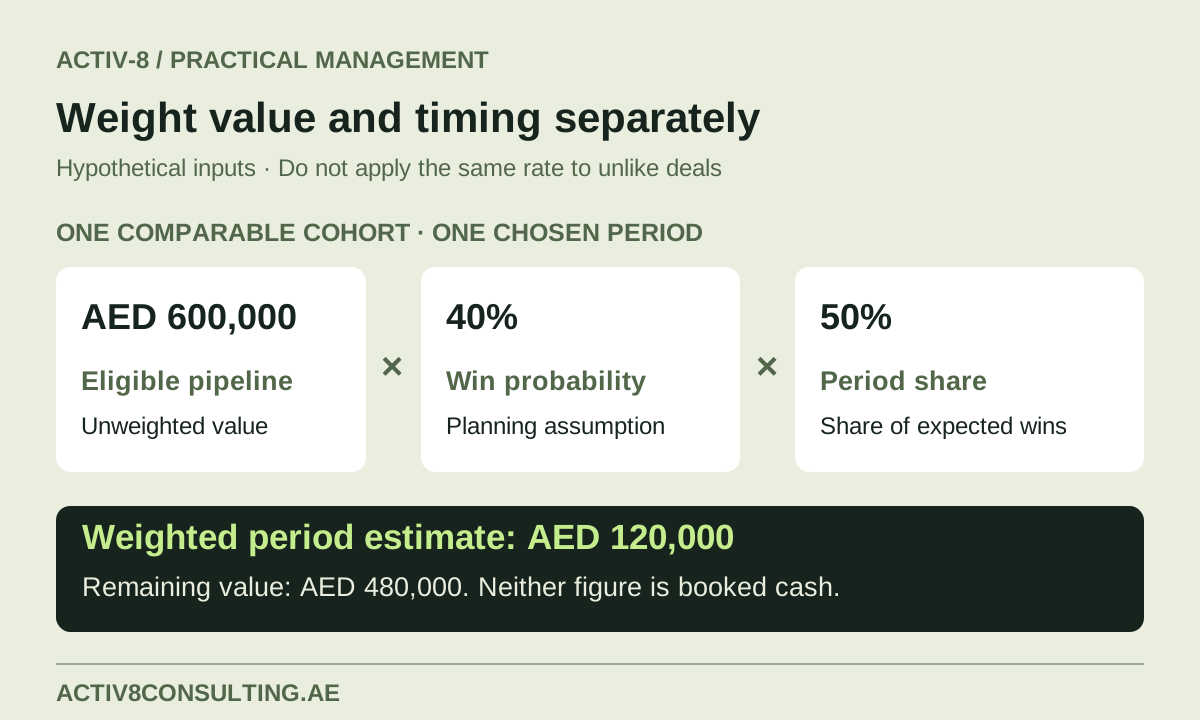
Consider an illustrative group of comparable UAE service opportunities with a total eligible value of AED 600,000. Management uses a 40% win probability based on its stated planning assumptions. It estimates that 50% of the value expected to be won would close in the chosen period. The weighted period estimate is AED 600,000 multiplied by 40% and 50%, giving AED 120,000.
The unweighted eligible pipeline remains AED 600,000. The difference between that value and the period estimate is AED 480,000. That remaining value is not automatically lost business: it contains uncertainty about winning and timing outside the chosen period. It also is not an additional amount to add to the AED 120,000 forecast.
These inputs are fictional and are not recommended conversion rates. If the group contains materially different opportunities, split it into relevant cohorts or calculate each deal separately. A weighted estimate of AED 120,000 does not establish that exactly that amount will be won. A small number of large opportunities can produce actual results far above or below the mathematical expectation.
Use the calculator for one coherent group
The calculator on this page accepts total eligible pipeline value in AED, win probability and the share expected to close in the chosen period. It returns the weighted period estimate, the unweighted value and the remaining value outside that estimate. Use one comparable cohort and one time horizon at a time.
Write down where each input comes from before experimenting. If you do not have a reliable historical probability, label the number as a planning assumption and test alternatives. Compare what changes when the win probability falls or expected closing moves later. The exercise is useful when it changes a capacity, spending or follow-up decision.
Do not treat the calculator as a deal-management system or a revenue-recognition tool. It cannot inspect customer evidence, detect duplicate opportunities or determine payment dates. Retain deal-level records and connect the result to a separate delivery and cash plan. The tool simplifies arithmetic; it does not remove the need for judgement.
Compare the forecast with actual outcomes
Preserve a dated snapshot before the forecast period begins. At review, compare expected wins with actual wins, losses and delays. Record whether differences came from value, probability, timing or missing opportunities. If you only inspect the current pipeline after editing it, you lose the evidence needed to improve forecasting.
Look for systematic patterns. Does the team repeatedly move close dates? Are late-stage opportunities less qualified than their label suggests? Does a particular service have a longer decision process? These findings should lead to clearer stage criteria or operating changes, rather than a general instruction to make the forecast more accurate.
Use the management reporting pack guide to show the pipeline alongside orders won, delivery commitments and cash. Keep the relationships visible without combining unlike measures into one revenue headline. A manager should be able to trace why an encouraging sales outlook has or has not changed the operating plan.
Turn the forecast into proportionate commitments
Test a downside in which a major deal slips or a cohort converts below the central assumption. Ask which costs and capacity commitments remain sensible under that case. Avoid hiring, ordering or spending solely because the unweighted pipeline is large. Equally, do not ignore credible demand until every opportunity is signed if preparation needs time.
Assign actions to the uncertainties that can be clarified. Confirm the customer decision process, resolve scope, check timing and document the next step. Some uncertainty will remain, so match the size and reversibility of your commitments to the quality of the evidence.
Activ-8 CRM and sales systems consultancy can help align opportunity stages, follow-up ownership and management forecasting. The aim is a pipeline your team can explain and act on, with a clear separation between possible sales, expected wins and money actually collected.
TRY IT WITH YOUR NUMBERS
Sales pipeline forecast calculator
Estimate one comparable group of opportunities. Use a win probability and a separate timing assumption for wins in your chosen period.
A planning estimate, not booked revenue or cash received. Use evidence from comparable opportunities, forecast mixed deals separately and convert wins into a delivery and collection schedule. Avoid counting the same timing risk twice.
How this calculation works
Weighted estimate = eligible pipeline value × eventual win probability × share of wins expected in the period. Do not apply a timing adjustment again if your win probability already includes that period.
Your inputs stay in this page and are not sent to Activ-8. Download the scenario if you want to keep it.
Discuss what this means for your business ↗