THE STARTING POINT
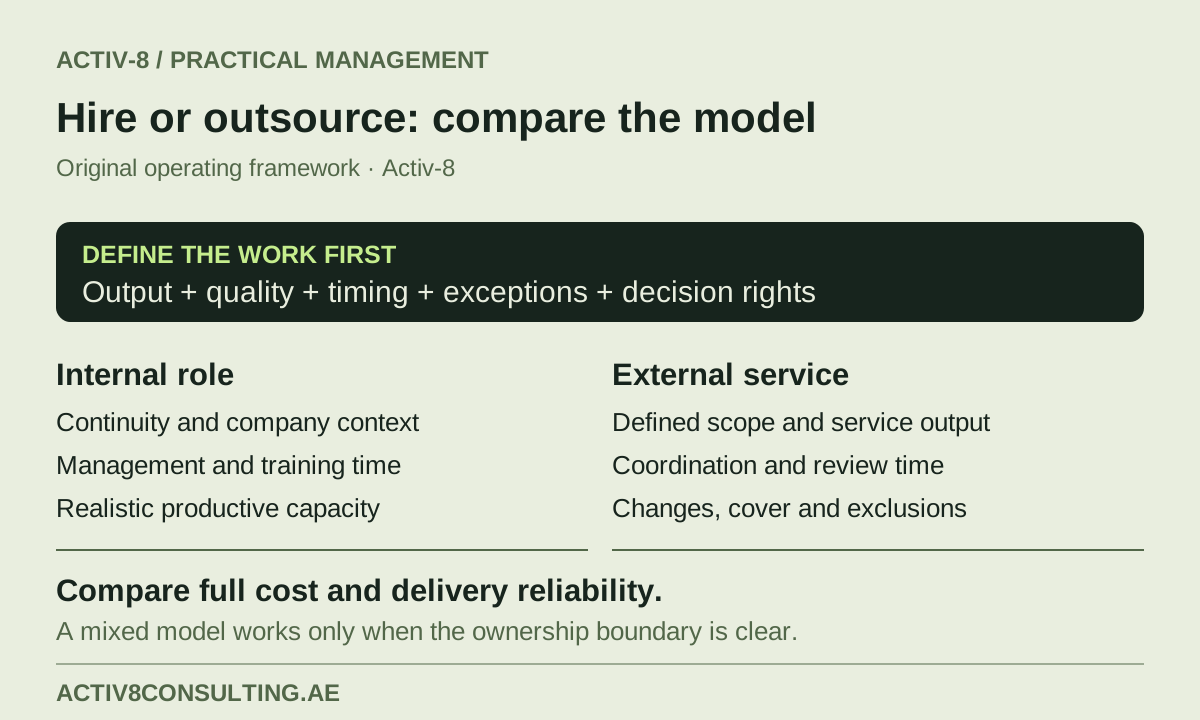
Compare complete delivery models, including coordination and exceptions, before choosing an employee or an external provider.
Compare complete delivery models
Choose between hiring and outsourcing by comparing the work you need, its timing, the capability you must retain and the full cost of each option. Hiring can provide continuity and direct control; outsourcing can give access to a defined service or flexible capacity. Neither is automatically cheaper. For a UAE business, the first question is whether the demand is stable and well specified enough to justify the commitment you are considering.
Describe the work before choosing the resource
Write down the output you need, who uses it and how you will judge it. “We need help with operations” is too broad to price or manage. “We need approved customer orders scheduled, checked and confirmed each working day” creates a more useful basis for comparison. Include the exceptions, because they often consume more time than routine work.
Separate tasks that require company knowledge from tasks that can be delivered through a clear specification. A provider may handle a repeatable production activity effectively while an internal manager retains customer commitments and prioritisation. Conversely, a role requiring constant informal coordination may become harder to manage across an external boundary.
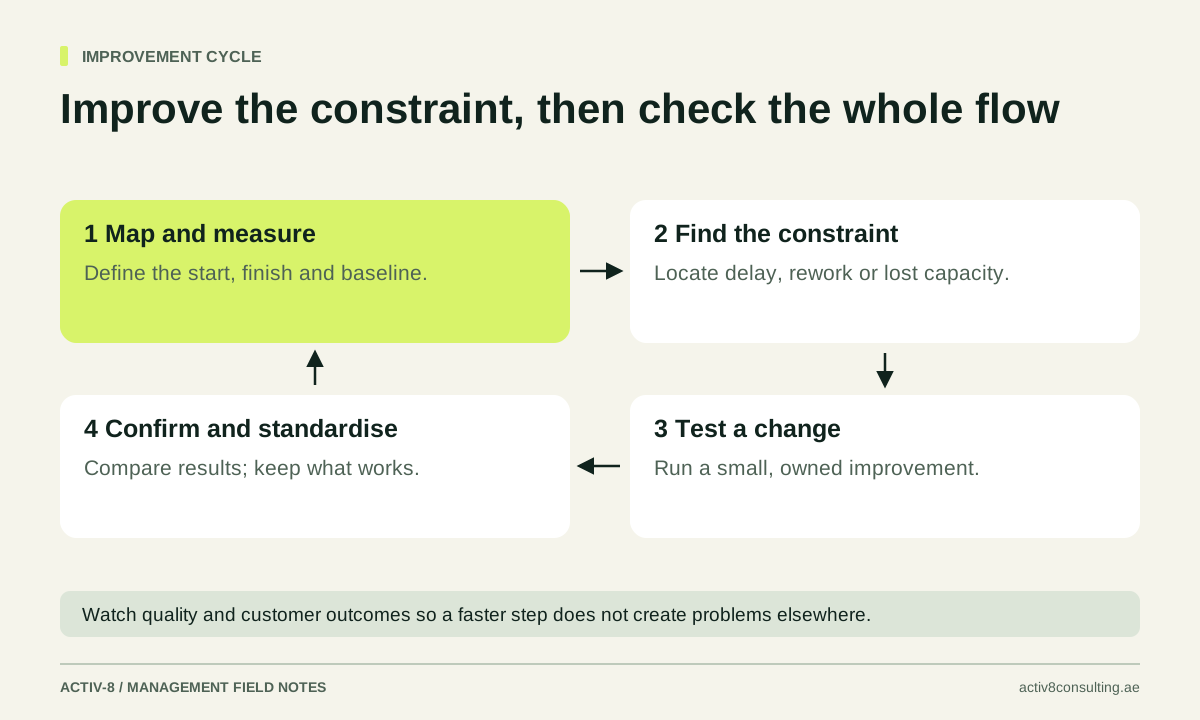
Map the current process before assuming that the missing resource is a person. Our business process improvement guide explains how to identify unnecessary work and repeated corrections. Hiring somebody into a broken process can increase capacity without resolving the underlying delay. Outsourcing it can add another handover to the same problem.
Measure demand in a consistent period
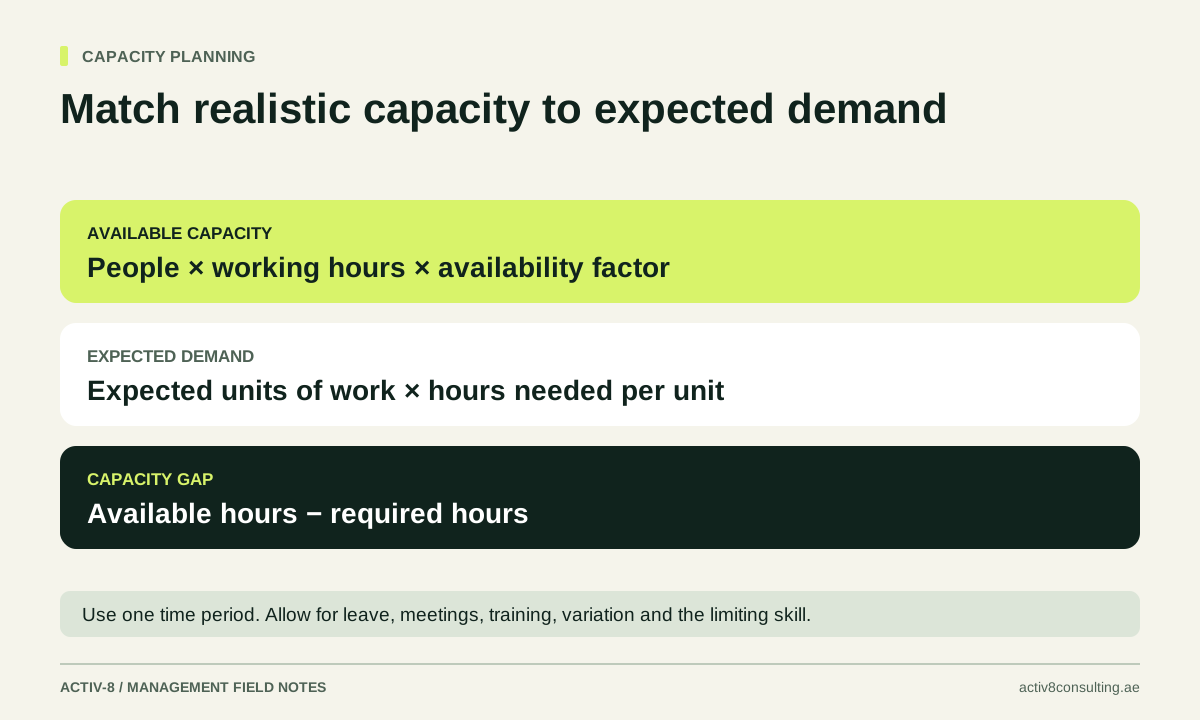
Estimate the volume of comparable work and the time needed to complete each unit to the required standard. Include checking, documentation and normal exceptions. Then compare the demand with the productive hours available from the proposed resource. Do not divide by a full calendar month of hours that includes time the person cannot actually spend on this work.
Use the capacity calculator on this page for one team, one comparable work type and one consistent period. Enter people, available hours per person, the share available for this delivery work, expected units and minutes per unit. The result shows delivery capacity, demand and the resulting surplus or gap. It does not choose the employment or supplier arrangement for you.
Monthly figures are useful for budgeting, but check the weekly or daily schedule separately. A team can have surplus monthly hours and still miss a deadline because the work arrives together or requires one scarce skill. Consider absence cover, review availability and the cost of urgent changes before treating average capacity as a complete plan.
Compare full operating costs in AED
For hiring, build a budget from the actual proposed compensation and other costs your business would incur, together with equipment, systems, recruitment, training, supervision and cover. Use information specific to your organisation. This operational comparison does not assume particular UAE salary levels or make claims about employment requirements.
For outsourcing, include the quoted service, setup, onboarding, internal coordination, review, corrections, change requests and any minimum commitment. Check what the provider's price excludes. An attractive per-unit rate may depend on a stable specification and volume that your business cannot yet provide. Keep one-off and recurring costs separate so the comparison does not favour either option artificially.
Value internal management time consistently. If you include supervision for an employee but ignore supplier management, the comparison is distorted. At the same time, distinguish capacity value from additional cash payments. Existing manager time has an opportunity cost, but reducing it does not automatically reduce the payroll next month.
A hypothetical scheduling decision
Consider a UAE service company needing 160 scheduling tasks a month, each taking 45 minutes including checking. Required delivery time is 120 hours. A proposed internal role has 160 available monthly hours, with 75% realistically available for this work. That also produces 120 hours of delivery capacity, so the plan has no allowance within that estimate for demand above the stated level.
Suppose the illustrative recurring cash budget for the internal option is AED 11,500 a month, and onboarding costs AED 6,000 once. An external provider quotes AED 9,000 monthly for the defined volume. The business expects AED 1,200 of additional internal review and coordination capacity value. The external comparison is therefore AED 9,000 in quoted recurring cash plus AED 1,200 in internal capacity, subject to verifying scope and exceptions.
Those figures do not prove outsourcing is best. If the provider excludes urgent rescheduling, the apparent saving may disappear when actual demand is tested. If the employee can productively perform other necessary work during quieter periods, that broader role may be valuable. Compare complete, realistic operating models rather than two isolated headline prices.
Decide what control must remain inside
Some decisions need a clear internal owner regardless of delivery arrangement. Customer promises, spending authority, priority conflicts and acceptance of completed work should not become ambiguous simply because an external provider is involved. State which decisions the provider can take and which require approval.
Check how quickly the business needs to change direction. If priorities shift several times a day, the resource needs enough context and access to respond responsibly. That can favour an internal role, a closely integrated provider or a redesigned process with more stable planning. The answer depends on the work, not on a general belief that one model is more agile.
Consider knowledge continuity as well. Document how instructions, customer context and work records remain accessible to the business. A capable employee may leave, and a supplier relationship may end. A sound operating model can transfer the work without relying entirely on one individual's memory or one provider's undocumented method.
Test quality and continuity before scaling
For a suitable bounded activity, run a paid or otherwise clearly agreed pilot with a representative workload. Include ordinary tasks, a realistic exception and a change in priority. Define acceptance criteria before the trial so that both parties know what good delivery means. Do not assess the model only on the easiest examples.
Track accuracy, completion time, review effort and escalation frequency. Ask the receiving team whether the output was usable without rework. A provider who completes tasks quickly but requires extensive correction may be transferring work back to your staff. An internal hire facing the same pattern may need a clearer specification or better training.
Plan continuity explicitly. Who covers absence, handles a backlog and resolves a system problem? What information must remain available? Where responsibilities are shared, record the handover and the owner of the final result. These are operational questions to settle alongside the appropriate professional review of any agreement.
Use a mixed model when the work supports it
The choice is not always one employee or one supplier. A business might retain customer-facing coordination internally and outsource a well-defined production task. It might use temporary external capacity while measuring demand before creating a permanent role. A mixed model works when boundaries are clear, not merely because it postpones a difficult decision.
Be cautious about splitting a small task across too many parties. The coordination burden can exceed the flexibility gained. Count the additional handovers and decide who owns completion from the customer's perspective. If nobody can make a prompt decision without consulting three organisations, the model needs simplifying.
Our capacity planning guide helps test the resource requirement before you decide how to source it. Keep separate scenarios for expected demand, a quieter period and a plausible peak. A decision that works only at exactly one volume is more fragile than its headline budget suggests.
Make the decision reviewable
Record the chosen option, the assumptions that make it sensible and the conditions that would trigger a review. Examples include sustained demand above capacity, unacceptable correction work or a change in the capability the business wants to own. Assign a review date and a manager who can make the next decision.
Compare actual costs and outputs with the original model after implementation. Explain differences rather than retrofitting assumptions to make the choice look successful. The purpose is to learn whether the resource arrangement supports reliable delivery at a cost the business can sustain.
Activ-8 operations consultancy can help define the work, test capacity and compare practical delivery models. A useful recommendation should make the trade-offs visible and leave your team with a clear basis for managing the option it chooses.
TRY IT WITH YOUR NUMBERS
Capacity planning calculator
Compare one team and a comparable type of work over one consistent period, such as a week.
Averages cannot reveal every skill bottleneck, deadline or demand peak. Check the real schedule and quality requirements before making a staffing decision.
How this calculation works
Delivery capacity = people × available hours per person × delivery share. Demand hours = work units × minutes per unit ÷ 60.
Your inputs stay in this page and are not sent to Activ-8. Download the scenario if you want to keep it.
Discuss what this means for your business ↗