THE STARTING POINT
Judge customer dependency by the effect of losing or delaying the account, not revenue share alone.
Measure the dependency in more than revenue
Your UAE business may be too dependent on one large customer when losing or delaying that account would create an operating or cash problem you could not manage within a realistic recovery period. Revenue share is a useful starting measure, but it is not enough. Examine contribution, cash collection, workload, specialist resources and the time needed to replace the relationship. There is no universal percentage that makes every business safe or unsafe.
A large customer can be commercially valuable. It may provide predictable demand, efficient delivery and a stable base for investment. The purpose of a concentration review is to understand the exposure and make deliberate choices, not to assume that every major account should be reduced.
Start with a consistent period and a clear definition of the customer group. Several trading names may belong to one economic relationship, while separate accounts may share the same decision-maker or source of demand. The underlying dependency matters more than the number of names in your sales report.
Calculate revenue and contribution concentration
Calculate the largest customer's revenue as a share of total revenue over the same period. Then repeat the exercise for contribution after the costs that vary with serving that customer. Use consistent cost definitions across accounts. A customer with a large revenue share may contribute less than expected if it requires substantial subcontracting, discounts or delivery effort.
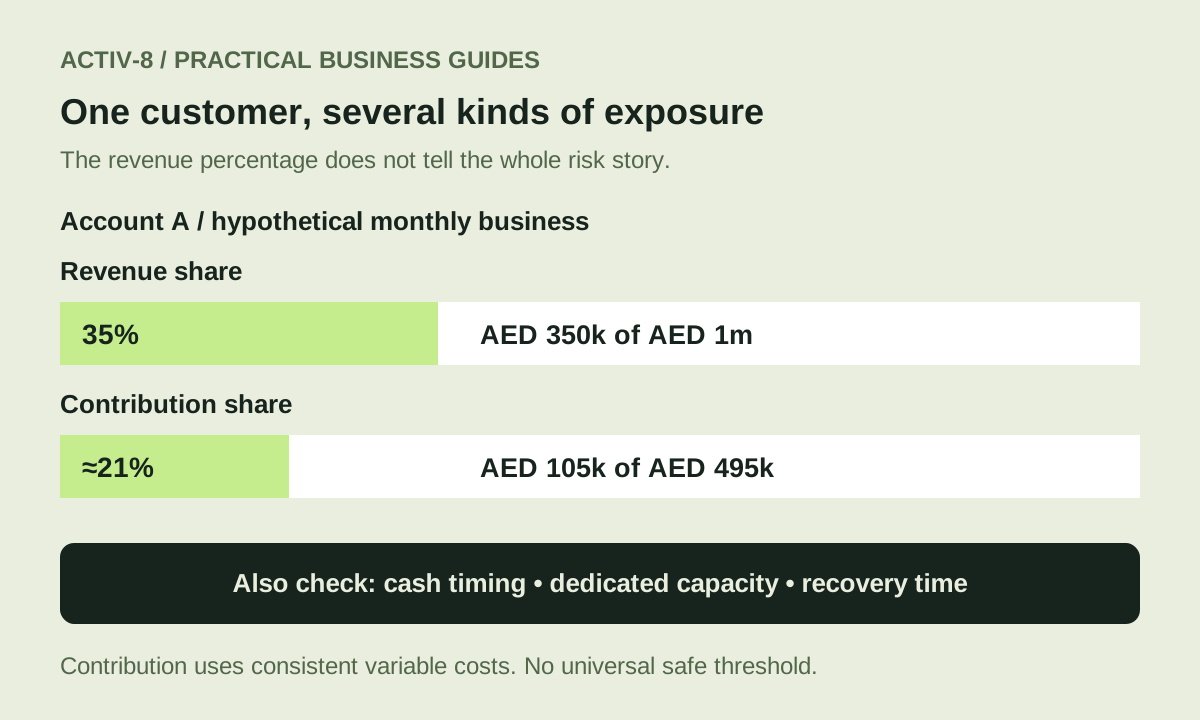
Consider a hypothetical business with AED 1,000,000 monthly revenue. Its largest customer generates AED 350,000, or 35% of revenue. Suppose that account contributes AED 105,000 after variable delivery costs, while the rest of the customer base contributes AED 390,000. The large account then represents about 21% of the combined AED 495,000 contribution.
That does not make the account unimportant. It shows that revenue share alone overstates its share of this particular contribution measure. The business should also inspect costs that cannot disappear quickly, customer-specific resources and the timing of cash. Each view reveals a different part of the exposure.
Map the resources tied to the relationship
Identify the people, equipment, capacity and management attention dedicated to the major account. Ask which resources could move to other work, how quickly they could move and what would be required. A technically transferable team may still need training or a different sales pipeline before its capacity becomes useful elsewhere.
Look for hidden dependencies. The customer may shape the service offer, require unusual reporting or consume much of the owner's time. It may also influence the timing of other jobs, because the team gives its requests priority. Losing the customer could therefore reduce workload but leave an operating model that is poorly suited to the remaining market.
Separate variable costs from costs that would remain in the near term. A subcontracted delivery cost may fall with volume. A dedicated system commitment or fixed facility cost may continue. This distinction is essential when estimating the effect of losing the account. Revenue disappearing does not mean an equal share of expenditure disappears with it.
Examine cash concentration and timing
Calculate how much of the cash expected over the next planning period depends on the account. Review the actual pattern of receipts, not only the stated payment arrangement. A profitable customer can still create funding pressure if payments are large, irregular or consistently later than expected.
Model a delay as well as a complete loss. If a major receipt moves by several weeks, identify the lowest projected cash balance and the commitments that fall due before collection. This can reveal a vulnerability even when the annual customer relationship remains profitable. Keep the assumptions visible and avoid treating a forecast receipt as money already available.
Consider whether work must be funded before the customer pays. Materials, subcontractors and staffing can increase the cash tied up in a growing account. Winning more of the same work may deepen the dependency rather than reduce it. Review the commercial arrangement with the relevant professional support where needed, while keeping the management model focused on timing and exposure.
Run a realistic loss-of-account scenario
Build a scenario in which the account reduces volume or stops purchasing at a defined point. Show the revenue lost, variable costs avoided, costs that remain and the timing of any response. Do not assume a replacement customer appears immediately at the same price and margin.
Using the earlier illustrative example, losing AED 350,000 of monthly revenue also removes AED 245,000 of the account's variable costs, leaving an initial contribution reduction of AED 105,000. If the business cannot reduce its continuing fixed commitments quickly, that AED 105,000 is the relevant starting pressure on the operating result. The cash effect may occur on a different timetable because existing receivables and payments still move.
Then test recovery options. How long would it take to win suitable replacement work? What sales effort would be required? Could capacity be redeployed? Use a range of assumptions and identify the point at which the business needs a different response rather than relying on a single optimistic replacement date.
Check whether apparent diversification is real
Ten customers are not necessarily ten independent sources of risk. Several may belong to the same group, depend on the same end market or reduce spending for the same reason. A business serving different accounts within one narrow demand pattern can still be exposed to a shared downturn.
Group customers in ways that reflect how demand behaves. The useful categories may include sector, service type, contract pattern, geography or route to market. Avoid creating more categories than the evidence supports. The purpose is to reveal common dependencies, not produce a colourful chart with arbitrary segments.
Also check acquisition concentration. If most new business comes through one referral partner or platform, a diversified customer list may conceal a concentrated source of future demand. Our business risk register guide provides a structure for recording these exposures, the evidence behind them and the actions that would reduce their impact.
Diversify without destroying a good account
A sensible response may be to grow other profitable relationships while continuing to serve the major account well. Reducing the large account abruptly can damage contribution and release capacity before replacement demand exists. The objective should be a stronger business, not a lower concentration percentage achieved at any cost.
Choose the diversification route carefully. New customer segments may require different marketing, service expectations or delivery skills. Compare the contribution and management effort, not just the number of new logos. A collection of small, difficult accounts can be less resilient than a well-managed mix that includes one large customer.
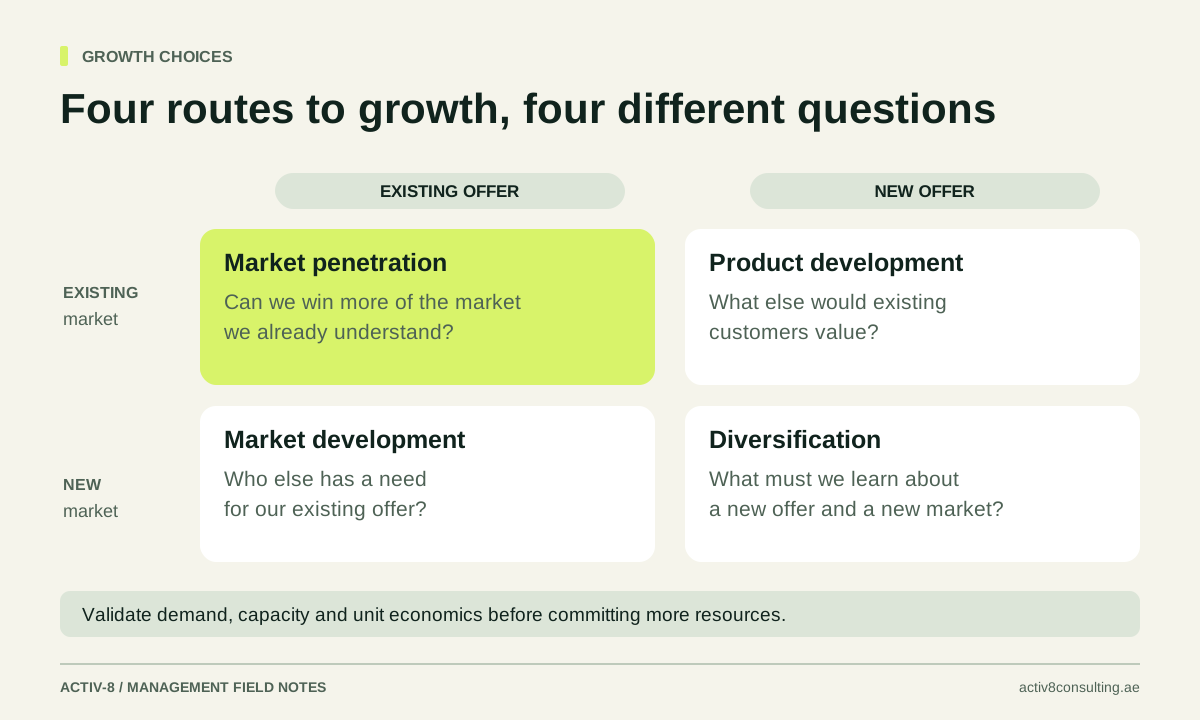
Our business growth strategy guide helps connect the risk response to a commercial choice. You might prioritise a repeatable service for a second segment, strengthen referrals from several sources or build sales capability beyond the founder. Each option should have an owner, a resource requirement and evidence that will determine whether to expand it.
Set monitoring triggers that lead to action
Choose a few signals that matter for the relationship and the wider business. These may include a change in ordering frequency, a delay in a major receipt, a decline in contribution or increasing dedicated capacity. Set review triggers based on your own tolerance and recovery options rather than borrowing a percentage with no connection to your economics.
Assign an owner to monitor the account and another person to challenge the assumptions where practical. A manager close to the relationship may recognise early changes, while a finance or operations colleague may see a dependency that sales overlooks. Discuss the evidence respectfully and keep customer service separate from internal risk concerns.
Use the downloadable concentration worksheet to record revenue, contribution, expected receipts, dedicated resources and response options. It includes an illustrative row and blank working rows. The worksheet does not determine a safe threshold; it makes the exposure visible so leadership can decide what to do about it.
Turn the review into a proportionate plan
Summarise the dependency, the downside scenario and the time needed to respond. Choose a small number of actions that strengthen the business whether or not the customer leaves. Better cash visibility, a broader pipeline and clearer resource flexibility can all improve decisions without undermining a valuable relationship.
Review the plan when the account grows, the service changes or the business takes on a new fixed commitment. Concentration is dynamic: an account that was manageable at one scale can create a different risk after a major expansion.
Activ-8's management consultancy services help connect customer economics, operating capacity and growth choices. The goal is to understand the relationship clearly enough to keep its value while reducing the consequences of a change you cannot fully control.
PUT IT INTO PRACTICE
Customer concentration review worksheet
Use the same period and cost definitions for all accounts. Record revenue, contribution, expected cash, dedicated capacity and response options. The example is illustrative and provides no universal safe concentration threshold.
Download the worksheetCSV file · Opens in Excel or Google Sheets · No sign-up required